




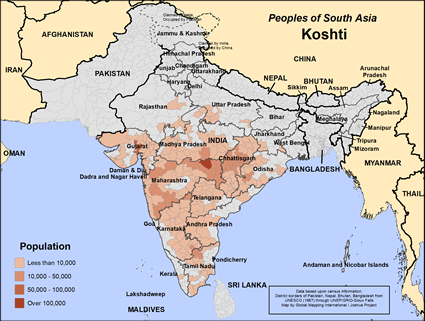
The Koshti are a traditional weaving community found primarily in the Indian states of Maharashtra, Chhattisgarh, Madhya Pradesh, and neighboring regions. They are especially known for their historical involvement in handloom weaving and textile production. Most Koshti people speak Marathi, Hindi, or regional dialects depending on where they live. Over generations, weaving became deeply tied to their social identity and family livelihood, with weaving skills often passed from parents to children.
Historically, the Koshti produced cotton cloth and other woven goods for local markets and village communities. Different regional branches of the community developed specialized weaving styles and techniques. As industrial textile production expanded, many traditional weavers struggled economically, forcing some Koshti families to leave handloom work for factory labor, farming, transportation, construction, or urban employment. Even so, weaving traditions still remain an important part of community heritage and identity in many areas.
The Koshti community has lived for centuries within the broader Hindu caste structure, which shaped marriage customs, occupation, and social relationships. While modernization and education have opened new opportunities for some families, many still maintain strong ties to traditional customs and extended family networks.
The daily lives of the Koshti vary between rural villages and growing urban centers. Some families continue traditional weaving using handlooms, producing cloth, garments, towels, and decorative textiles. Others now work in mills, shops, transportation services, farming, small businesses, or wage labor due to declining income from handloom production. Economic stability differs greatly between families, especially as handmade textile work faces competition from large-scale manufacturing.
Family life is usually close-knit, with respect for elders and strong community relationships playing important roles. Marriages are commonly arranged within the community, and family gatherings, weddings, and religious festivals remain central to social life. Meals often include rice, flatbreads, lentils, vegetables, and locally available foods depending on the region.
In weaving households, work can involve the entire family. Men may operate looms or manage sales while women help prepare thread, dye materials, and assist with production. Long working hours and uncertain market prices can create financial strain for many artisan families. Younger generations increasingly seek education and urban employment outside traditional weaving occupations.
The Koshti primarily follow Hinduism and participate in both mainstream Hindu worship and local folk religious practices. Worship commonly includes devotion to Hindu gods and goddesses such as Shiva, Vishnu, Durga, Ganesh, and regional deities connected to family or village traditions. Religious festivals, temple visits, ritual offerings, and ceremonies tied to births, marriages, and deaths are important parts of spiritual life.
In some communities, folk beliefs involving ancestral spirits, ritual purity, astrology, and protection from evil influences also shape religious practice. Religious identity is often closely connected with family tradition and social customs. Belief in karma and rebirth strongly influences worldview and moral understanding.
Though some Koshti may have encountered Christianity through nearby churches or schools, many still have limited understanding of the biblical gospel. Jesus may be viewed as one religious teacher among many rather than the unique Son of God who alone provides forgiveness of sins and reconciliation with God.
Many Koshti families need greater economic stability as traditional handloom industries continue to decline in some regions. Access to education, healthcare, vocational training, and sustainable employment opportunities remains important, especially for younger generations facing uncertain economic futures. Artisan families may also struggle with debt, fluctuating market demand, and competition from industrial textile manufacturing.
Spiritually, the Koshti need clear access to the gospel in their own languages and cultural setting. Many have never heard a biblical explanation of salvation by grace through faith in Jesus Christ. Faithful local churches, Scripture distribution, discipleship, and long-term relational ministry are needed so the gospel can take root within Koshti families and communities. Existing believers from nearby language groups can also play an important role in sharing Christ with them.
Pray that the Koshti people will hear a clear presentation of the gospel in their own language and come to faith in Jesus Christ.
Pray that God will strengthen and raise up believers who can disciple Koshti families and establish biblically faithful churches among them.
Pray that families facing economic hardship from declining weaving industries will find stable livelihoods, educational opportunities, and practical support.
Pray that the Koshti people will be adopted through the People Group Adoption program so that ongoing prayer, evangelism, discipleship, and church planting efforts will continue among them.
Scripture Prayers for the Koshti in India.
https://en.wikipedia.org/wiki/Koshti
https://www.india9.com/i9show/Koshti-Community-45669.htm
https://peoplegroups.org/explore/GroupDetails.aspx?peid=41286
https://en.wikipedia.org/wiki/Handloom_weaving_communities_of_India
| Profile Source: Joshua Project |




