


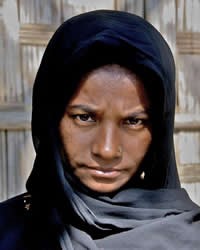

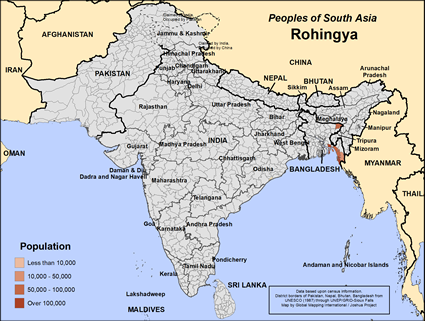
Originating from the Rakhine State in Myanmar, the Rohingya people group continues their quest to adequately adjust from Burmese refugees to Pakistani settlers. The majority among the Rohingya presently in Pakistan have formed large clusters in and surrounding Karachi. This people group has historically migrated for centuries out of survival, along with pursuing employment security and relishing religious freedom. The profiled Rohingya transversed west through Bangladesh and across India before ultimately finding stability in Pakistan. The Rohingya fled initially from their home country due to civil unrest in Myanmar and the heavily religious Buddhist persecution against the Rohingya, since the majority in this people group are devout Muslims. The Rohingya people group are also reported to have settled in multiple nations significantly large numbers.
The Rohingya communities speak their namesake language of Rohingya. Merging from other nearby dialects from Myanmar, the current usage of the Rohingya language in Pakistan has been significantly altered, with the vocabulary progressively merging with Bengali while the Rohingya remain in Pakistan. Even the ways through which the Rohingya practice their Islamic faith experienced linguistic adjustments. In accordance with Islamic culture, men and women typically separate for nearly all public activities. Their work that both genders can secure is among the lowest merchant class status of the Pakistani economy, which Pakistan considers as the "informal economy," with such represented occupations as day fishers, textile and garment seamstresses, vegetable-selling vendors, and jewelers. Rohingya women have gained better stability with economic opportunities in Pakistan rather than in Myanmar, so thousands of these refugee women have entered the Pakistani workforce to pursue a better-yet-limited livelihood for themselves and their family units.
Nearly all the Rohingya people have carried their devotion across national borders by practicing the Sunni tradition of the Islamic religion. Accepted in mass by families when Islamic messengers travelled and shared what would become a minority religion in Myanmar, the Rohingya faithfully follow their beliefs. Mystical elements and folk traditional practices, in support but also at times in conflict with orthodox Islamic theology and methodology, have crept into the philosophy and implementation held by the Rohingya tribespeople observing in Pakistan. As a result of the religious landscape throughout Pakistan, mosques remain the central meeting place for social engagement to take place among the Rohingya tribespeople. In an effort towards assisting their fellow Muslims, the Pakistani government is becoming more sympathetic towards tracking the Rohingya's whereabouts and offering some aid assistance.
The Rohingya people group's status in Pakistan remains unstable, since Pakistan does not classify these individuals as asylum seekers or technically as refugees. Without granting a pathway towards citizenship and even the luxury of obtaining identification cards, the Rohingya people group remain severely stunted, preventing them to access any form of public education, health coverage, and the means to open bank accounts, let alone advocate for their own interests in any government or public forum. While prior top-ranking government officials in Pakistan have expressed discontent over the lack of support to assist the Rohingya, classifying the Rohingya refugees remains difficult, since current censuses in Pakistan have deliberately labeled them as Bengali or as another indigenous people group which is exclusively native to Pakistan. And with Myanmar's refusal to receive any documentation of these individuals, the Rohingya people group remain stateless while residing in Pakistan.
Partner in prayer for Pakistani and international Christian believers alike to answer God's calling upon their lives, so they move to share the gospel truths with the Rohingya with entire communities, so individual family members remain in communication with the families and friends and avoid ex-communication against hostile members.
Pray for the entire Old Testament to be translated into the Rohingya language, complimenting the efforts for the translated New Testament in entirety recently in 2024. Pray additionally that current printed and digital resources continue to reach the Rohingya people group as they desperately need.
Intercede for peace, healing, and progress among the Rohingya.
Pray for the trauma-stricken Rohingya to receive healing in the name of Jesus Christ.
Additionally pray that the Pakistani government would pave a pathway so the Rohingya people group can receive a feasible pathway towards being officially recognized as refugees.
Pray that men and women can live in Godly ways by reading what the Bible states and following what the Bible indicates.
Scripture Prayers for the Rohingya in Pakistan.
https://grokipedia.com/page/Rohingya_people
https://en.wikipedia.org/wiki/Rohingya_refugees_in_Pakistan
https://www.hrw.org/news/2017/09/12/pakistan-should-back-rohingya-rights-abroad-and-home
https://www.arabnews.com/node/1174656/amp
| Profile Source: Joshua Project |




