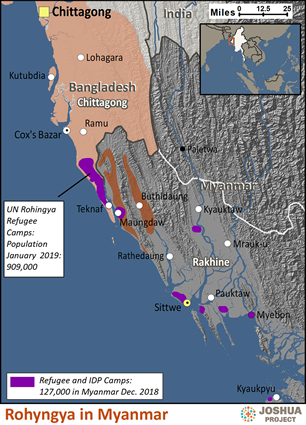

Rohingya people are crammed into a small area of northern Rakhine State along Myanmar's border with Bangladesh. The Rohingya population is extremely fluid due to the ongoing genocide waged against them, which has forced hundreds of thousands of people to flee. The tumult is so great that more than 2. million now live scattered across the globe, and the United Nations estimates that one in every seven stateless people in the world today are Rohingya. As they have fled ethnic cleansing, the number of Rohingya in Bangladesh has mushroomed to 1. million, with more still arriving. They are confined in massive "refugee cities" in the Cox's Bazaar area, where frequent fires, gang activity, rape and murder continue to add misery to their lives. The U.S. government's 2025 decision to cancel USAID has further exacerbated their suffering, with many refugees now facing starvation.
The word "Rohingya" is outlawed in Myanmar, reflecting the intense hatred the government has against them. Instead, they are labeled "Bengali illegal immigrants." The British first mentioned the Rohingya in Rakhine State in 1799, with the 1931 census returning 122,705 "Zerbadi" people. The Zerbadi, also known as Faqir, are a subgroup of Rohingya described as "children of mixed marriages between Indian Muslim men and Burmese women, who stubbornly adhered to their Muslim names and racial customs, though for all practical purposes they were Burmans."
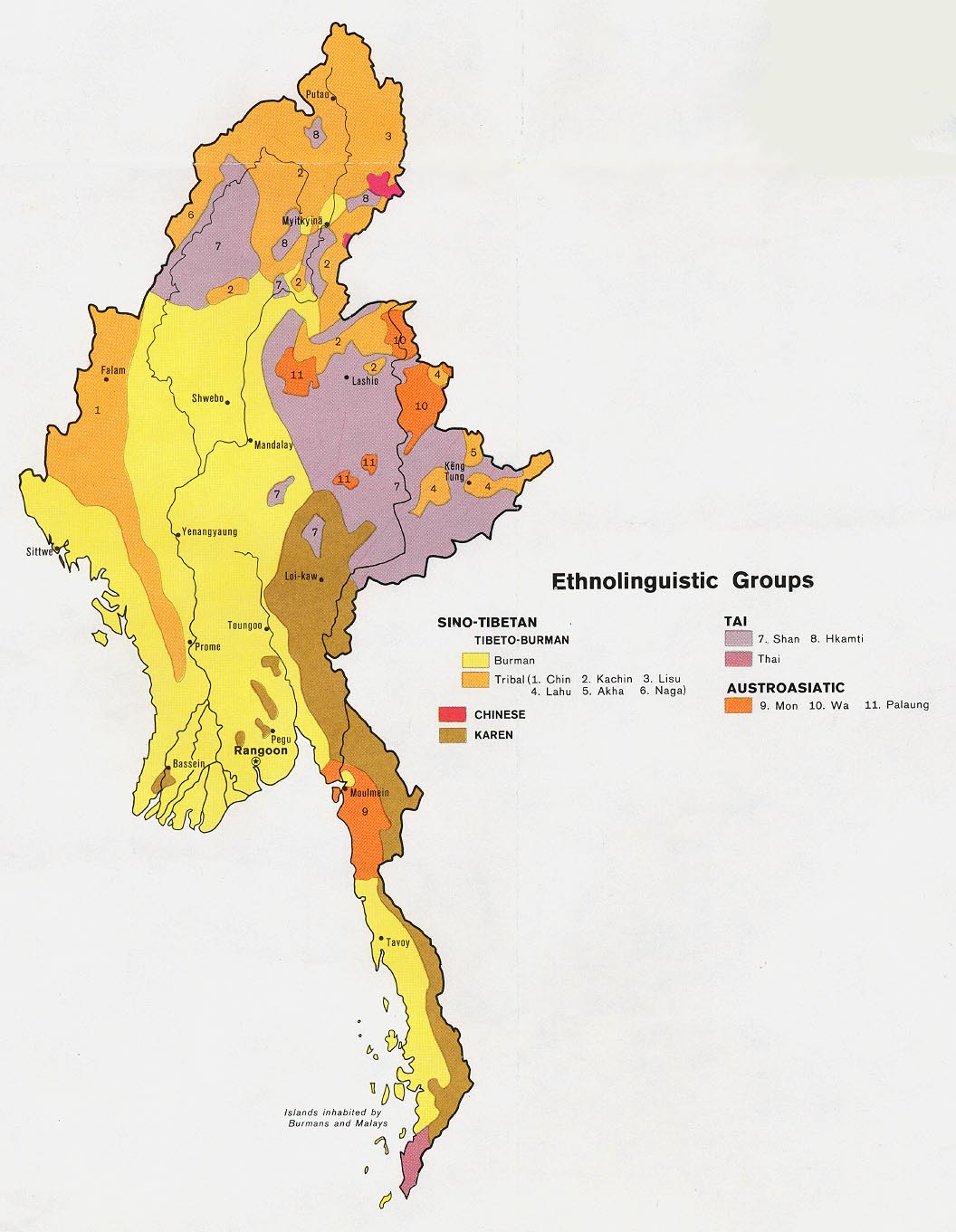
Rohingya is part of the Indo-European language family, which sets it apart from the dominant vernaculars in Myanmar which are Tibeto-Burman. It is related to the Chittagonian language spoken in Bangladesh, but neither Rohingya nor Chittagonian is intelligible with Bengali. Over the years Rohingya has used many written forms, utilizing the Arabic, Hanifi, Urdu, Roman, and Burmese alphabets.
The Rohingya claim to be descended from Arab, Moghul, and Portuguese traders who moved to Rakhine State at least a millennium ago. Arab merchants are said to have first sailed across the Bay of Bengal to Rakhine in the third century. The Burmese dismiss all such claims as myths and fabrications. Hatred of the Rohingya dates back centuries, resulting in a succession of massacres and campaigns designed to drive them out of Myanmar. This stems from a widely held belief that the Rohingya are an artificial construct from the British colonial era who have taken over part of Myanmar and seek to create an independent Islamic state.
Rohingya culture is being gradually erased in Myanmar, as hundreds of thousands of people have suffered "extrajudicial killings, summary executions, gang rapes, arson, torture, forced labor, and infanticides…. 116,000 Rohingya were beaten, and 36,000 were thrown into fires."
As the Rohingya have a much higher birthrate than other ethnic groups in Myanmar, many Buddhists feel threatened and see the Rohingya as an existential threat. The United Nations has officially labeled the actions against the Rohingya as "ethnic cleansing" and "genocide," but the killing continues. Fear and loathing of the Rohingya in Myanmar runs so deep that a winner of the Nobel Peace Prize, Aung San Suu Kyi, ignored all demands to stop the violence when she was in power.
All Rohingya people in Myanmar are Muslims, "practicing a Sufi-inflected variation of Sunni Islam." Their faith is entrenched as a key part of their ethnic identity. Records of Christian work among the Rohingya are very scarce, as violence and disease caused their area to become one of the most unreached parts of Asia.
No work among the Rohingya people is known to have taken place during the missionary era. Although there may be a tiny remnant of Christians among them in Myanmar, most believers live in Bangladesh and India, where they are heavily persecuted. It is notable that, for a language used by over three million people, not a single word of the Bible was translated into Rohingya until 2020, when the first Scripture portions were published. The New Testament was completed in 2025, but few copies have been distributed due to lack of availability and because most Rohingya are unable to read their script.
Pray for the Holy Spirit to bless Rohingya families with the realization that they need a sin-free Savior who offers abundant life.
Pray that God intervenes in their lives and helps them understand his value and worth in our lives.
Pray that their hearts soften up to know more and accept Jesus as their Lord and Savior.
Pray for a church planting movement to rise up in the Rohingya homeland.
Scripture Prayers for the Rohingya in Myanmar (Burma).
Asia Harvest, Copyrighted 2026 © Used with permission
| Profile Source: Joshua Project |
| Other PDF Profile |