




Starting in the 5th century there was a massive attack by the White Huns in what is now northern and northwestern India and Pakistan. About a century later the reigning Hindu-based Gupta Empire broke up, leaving the Subcontinent vulnerable to Muslim invaders from the north. As time went on, invaders took over land and integrated with the settled peoples of this region. Tribal leaders, especially those involved with defense, were accepted as Kshatriya, the second highest varna (major type of castes) in Hindu society, while their followers became the fourth and lowest varna. Priests became the Brahmins, the highest of the four varnas.
The Rajputs, who were part of the Kshatriya varna, became politically important in the seventh century. From around 800 AD Rajput dynasties ruled northern India. Petty Rajput kingdoms were the main obstacle for Muslim domination of the Hindu subcontinent. For more than 500 years Rajputs were the warriors who defended kingdoms from invaders and conquered others. When possible, Rajputs settled down, became nobles, and enjoyed the lives of landed gentry.
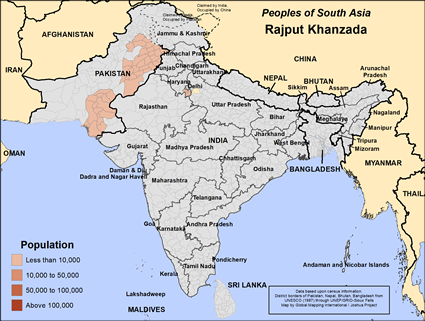
Over a period of a couple hundred years, invaders penetrated the Rajput wall that protected the Subcontinent. Some Rajput subgroups converted to Islam during this time. Among them were the Khanzadas. Khanzada is a Persian translation of the word "Rajput." Most moved to India during the 1947 Partition, but some remain in Haryana, India. They converted to Islam during the rule of Sher Shah Suri and claim descent from Bariar Singh, a Bachgoti Rajput.
Today the Khanzada Rajput people are primarily an agricultural community. The zamindari system made them land-owners, but now that system has been dismantled, most do not have land. Those who have lost land holdings have become employed in service and even wage labor jobs. Khanzada women earn money by weaving, embroidery and making handkerchiefs. For women, toe-rings, nose-pins and glass bangles are common symbols for being married. Rajput Khanzada Rajputs often intermarry with other Muslim communities in India's Uttar Pradesh state.
Khanzada Rajputs are usually Sunni Muslims, though there are a couple of communities are Shia. They are becoming more orthodox in their Islamic beliefs. As a result, they have set up madrasas to teach their sons the tenets of Islam.
In most of the Muslim world, common people depend on the spirit world for their daily needs since they regard Allah as too distant. Allah may determine their eternal salvation, but the spirits determine how well they live daily. For that reason, some Muslims appease spirits using charms and amulets to help them with spiritual forces. More orthodox Muslims consider these practices heretical and un-Islamic.
As people of influence and social status, the Rajputs are a key people to reach with the gospel. As converts to Islam they may be more open than many traditionally Muslim peoples to hear and receive of the love of Christ. Praise God that some Hindu Rajput have become believers but there are no known believers among the Muslim Rajput.
Pray that the Khandada Rajputs will be adopted through the People Group Adoption program so that they will have regular prayer and ultimately workers among them.
Pray for Khanzada Rajput culture to be renewed and enhanced by a work of the Holy Spirit and shaped into a God-centered and God-honoring mold.
Pray for the Holy Spirit to move among their family and community leaders to seek his face and enjoy his blessings.
Pray for the Lord to thrust out workers who will be compelled to nurture a disciple making movement among the Khanzada Rajput community.
Pray that soon the Khanzada Rajputs will have faith that will lead them to live honorable lives that will draw others to the savior.
Pray for spiritual discernment and a hunger for true spirituality.
Scripture Prayers for the Rajput Khanzada in India.
http://induhistory.blogspot.com/p/rajput-history.html
https://www.britannica.com/topic/Rajput
https://en.wikipedia.org/wiki/Rajput
http://allrajputyouthwing.weebly.com/muslim-rajputs-history.html
https://www.quora.com/What-is-the-difference-between-a-Kshatriya-and-a-Rajpoot
http://www.everyculture.com/wc/Germany-to-Jamaica/Rajputs.html
https://en.wikipedia.org/wiki/Rajput_clans
http://www.dawn.com/news/1077113
https://en.wikipedia.org/wiki/Category:Rajput_clans
http://www.jairajputana.com/list-of-rajput-clans-and-vansh.html
https://en.wikipedia.org/wiki/Khanzada_Rajputs
| Profile Source: Joshua Project |




