




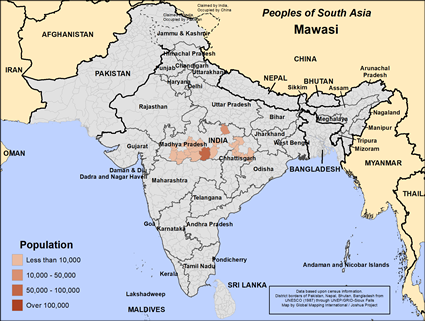
The Mawasi are a tribal community found mainly in the hill and forest regions of Madhya Pradesh and neighboring areas of central India. They are recognized among India's Scheduled Tribe and tribal populations, groups that have historically experienced social and economic marginalization. Most Mawasi speak Hindi or regional tribal dialects written in the Devanagari script. Their history is closely tied to rural agriculture, forest living, and tribal community structures that developed over generations in the rugged terrain of central India.
The Mawasi are also associated in some regions with the larger Korku tribal framework of central India, where "Mawasi" has historically referred to one of the important tribal subgroups. Tribal identity, clan relationships, and village councils have traditionally played significant roles in regulating social customs and maintaining community order. For centuries many Mawasi families depended on farming, hunting, forest gathering, and seasonal labor for survival. Economic pressures and modernization have gradually pushed younger generations toward wage labor and migration to towns and cities.
Like many tribal communities in central India, the Mawasi have historically lived somewhat separated from mainstream urban culture. Oral traditions, local customs, and close ties to land and nature continue to shape much of their identity and social life today.
Most Mawasi families depend on cultivation, agricultural labor, forest-related work, and seasonal wage labor for their livelihood. Some still hunt or gather forest products, though environmental restrictions and economic changes have reduced these traditional activities in many places. Younger Mawasi increasingly seek work as laborers in construction, transportation, factories, or city markets when local opportunities are limited.
Village life remains important among the Mawasi. Community councils often help resolve disputes, oversee marriages, and preserve tribal customs. Family and clan relationships are highly valued, and marriages are usually arranged through discussions between family leaders. Extended family networks commonly remain close, especially in rural settlements. Literacy levels remain low in many Mawasi communities, particularly in remote areas, which means oral communication and storytelling continue to play a major role in passing down traditions and values.
Meals commonly include millet, rice, lentils, vegetables, milk, tea, and locally available foods. Many use mustard oil in cooking. Some Mawasi men smoke beedis, a traditional South Asian hand-rolled cigarette. Housing in poorer areas may consist of mud, wood, bamboo, or thatched structures built from local materials. Seasonal hardship, uncertain rainfall, debt, and limited infrastructure continue to affect many families in tribal regions of central India.
The Mawasi are officially identified as Hindu, but their religious life often blends Hindu traditions with older tribal and animistic beliefs. Like many tribal peoples of central India, they may worship local deities, ancestral spirits, nature spirits, and regional gods alongside participation in broader Hindu festivals and customs. Spiritual beliefs are often closely tied to the land, forests, agriculture, and protection from sickness or misfortune.
In many tribal communities of India, fear of spirits, curses, supernatural powers, and ancestral influences strongly shapes worldview and daily life. Rituals and offerings may be performed to seek blessing, healing, protection, or favorable harvests. Local spiritual leaders or tribal priests may guide ceremonies connected to sickness, marriage, seasonal festivals, or community crises. Belief in karma, fate, and unseen spiritual powers is also widespread in Indian religious culture.
Although some Mawasi may have heard the name of Jesus Christ, many still have little understanding of the biblical gospel. In many villages there is limited access to mature churches, biblical teaching, discipleship, or Scripture resources in forms accessible to oral learners. Strong syncretism between Hindu practices and tribal religion can also make biblical truth difficult to distinguish from inherited spiritual traditions.
The Mawasi need improved access to education, healthcare, sanitation, stable employment, and economic opportunity, especially in remote tribal regions where infrastructure remains weak. Many families continue to face poverty, seasonal food insecurity, debt, and limited vocational opportunities. Children and young adults often have few educational resources, and migration for labor can place additional strain on family life and community stability.
Spiritually, the Mawasi need faithful gospel witness communicated clearly in culturally understandable and oral forms. Because literacy remains limited in many villages, oral Bible storytelling, audio Scripture resources, and relationship-based discipleship are especially important. The Mawasi need mature local believers, biblically grounded churches, and long-term ministry workers willing to patiently build trust within tribal communities. Existing Christians among neighboring tribal peoples also need encouragement and training so they can faithfully share the gospel with the Mawasi.
Pray that the Mawasi people will hear and understand the gospel clearly in their own language and place their faith in Jesus Christ.
Pray that God will raise up faithful local believers and church leaders who can disciple Mawasi families and establish biblically grounded churches among them.
Pray that Mawasi communities facing poverty, low literacy, limited healthcare, and unstable employment will experience practical help, provision, and lasting hope.
Pray that the Mawasi people will be adopted through the People Group Adoption program so that ongoing prayer, evangelism, discipleship, and church planting efforts will continue among them.
Scripture Prayers for the Mawasi in India.
https://en.wikipedia.org/wiki/Korku_people
https://en.wikipedia.org/wiki/Adivasi
https://en.wikipedia.org/wiki/Tribal_religions_in_India
https://www.egyankosh.ac.in/bitstream/123456789/87903/3/Unit-10.pdf
| Profile Source: Joshua Project |




