



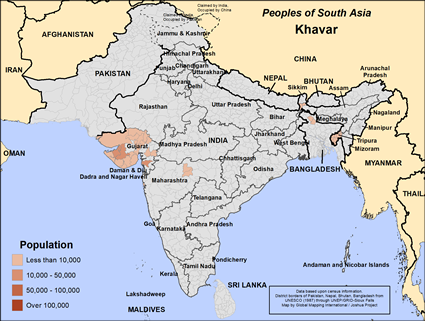
The Khavar are a Hindu community found primarily in the western Indian state of Gujarat. They speak Gujarati and are associated with the broader Rajasthani cultural sphere of western India. The name "Khavas" or "Khavar" historically referred to trusted attendants, retainers, or important servants connected to royal courts and regional rulers during the pre-independence period. Over time these hereditary service groups developed into a distinct caste community with their own clans, customs, and social identity.
The Khavar maintain several internal subdivisions and clans, and many trace connections to Rajput heritage because of their historical association with royal households. In some traditions, outsiders could be admitted into the community through established social customs, which distinguished them from more rigid caste structures. Their history reflects the complex social systems of western India where service communities, warriors, traders, and agricultural groups often interacted closely within princely states and regional kingdoms.
Today many Khavar families live in towns and villages across Gujarat. Modern education, urban migration, and economic change have gradually shifted some families away from older hereditary occupations into business, labor, transportation, agriculture, and other professions, though family identity and caste relationships still remain important parts of social life.
The daily lives of the Khavar vary depending on whether families live in rural villages or growing urban areas. Some work in agriculture, local business, transportation, construction, or wage labor, while others have entered government service, private employment, or small-scale trade. Economic conditions differ between households, with some families achieving stability while others continue to face financial pressure and limited opportunity.
Family loyalty and community relationships are highly valued. Extended family networks often remain close, and marriages are generally arranged within accepted clan and caste boundaries. Community elders and family leaders continue to influence social decisions and preserve traditional customs. Gujarati language, food, festivals, and regional traditions strongly shape cultural identity.
Meals commonly include flatbreads, lentils, rice, vegetables, yogurt, and regional Gujarati dishes. Religious festivals and family ceremonies remain important social events that strengthen community bonds. In urban areas, younger generations are increasingly exposed to modern education and technology, yet many families still maintain strong ties to traditional customs and ancestral identity.
The Khavar are primarily Hindu and are especially associated with the Vaishnav tradition of Hinduism. Worship commonly centers on devotion to Vishnu and related deities through temple visits, prayers, offerings, festivals, and household rituals. Alongside mainstream Hindu worship, clan-based religious practices remain influential. Many clans maintain devotion to their own family or clan deity believed to provide protection and blessing.
Traditional folk practices also continue among some Khavar communities. Shamans or local spiritual specialists may perform rituals intended to appease clan deities, ancestral spirits, or supernatural forces believed to affect health, prosperity, and family well-being. Ancestor observances and memorial rituals are practiced during specific festivals or family ceremonies. Fear of spiritual forces, belief in karma and rebirth, and concern for ritual purity shape much of their worldview.
Although Christianity is known in Gujarat, many Khavar still have little understanding of the biblical gospel. Jesus may often be viewed as one spiritual teacher among many rather than the crucified and risen Son of God who alone provides forgiveness of sin and reconciliation with God.
The Khavar need continued access to quality education, vocational opportunity, healthcare, and economic stability, especially for families facing financial uncertainty or limited employment opportunities. Rural communities may struggle with infrastructure and access to consistent services, while urban migration has created new social and economic pressures for younger generations.
Spiritually, the Khavar need faithful gospel witness in the Gujarati language and through long-term relationship-based ministry. Many have never heard a clear biblical explanation of repentance, grace, forgiveness, and salvation through Jesus Christ alone. Strong local churches, Scripture access, discipleship, and mature believers willing to serve among Gujarati-speaking communities are greatly needed. Existing Christians in Gujarat also need encouragement and boldness to share the gospel faithfully despite social pressure or opposition.
Pray that the Khavar people will hear a clear presentation of the gospel in Gujarati and place their faith in Jesus Christ.
Pray that God will raise up faithful local believers and church leaders who can disciple Khavar families and establish biblically grounded churches among them.
Pray that Khavar communities facing economic uncertainty, social pressure, or limited opportunities will experience practical help, stability, and hope.
Pray that the Khavar people will be adopted through the People Group Adoption program so that ongoing prayer, evangelism, discipleship, and church planting efforts will continue among them.
Scripture Prayers for the Khavar in India.
https://peoplegroups.org/people_groups/pg041663/
https://en.wikipedia.org/wiki/Caste_system_in_India
https://pmc.ncbi.nlm.nih.gov/articles/PMC10764522/
https://gijn.org/resource/guide-investigating-caste/
| Profile Source: Joshua Project |




