




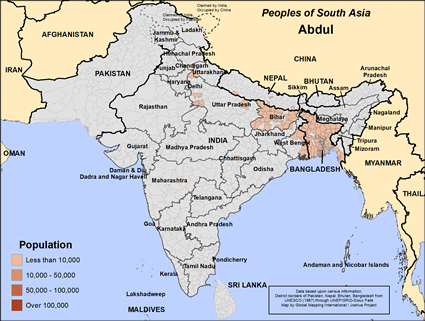
The Abdul people of Bangladesh are believed to have connections to the Abdal Muslims, a term historically used in parts of the Islamic world to describe devoted or spiritually significant individuals, sometimes understood as "substitutes" or "lieutenants." The precise origins of this group are not well documented, but they are recognized for a long-standing cultural identity tied to music and performance. In neighboring regions of India, similar communities are often called Dafali, referencing their association with the daf (a type of percussion instrument). Over time, this identity has remained closely tied to their occupational and social role, contributing to their distinct place within broader Bengali society.
The Abdul people often live on the margins of society, with many families experiencing low social standing and economic instability. Traditionally, some earn a living through musical performance—singing, drumming, and playing percussion instruments in public or from village to village. Others may rely on alms, small trade such as selling perfume, or informal labor.
During Ramadan, some Abdul men continue the custom of waking early and traveling through villages, playing their instruments and calling out praises to Allah, a practice that reinforces both their religious devotion and their cultural identity. Their reputation as "wandering singers" or even "wandering Muslim saints" reflects how they are perceived in some areas. Family life is typically close-knit, with strong communal ties, and their daily routines are shaped by both economic necessity and religious observance.
The Abdul people are Sunni Muslims, aligning with the majority religious tradition of Bangladesh. Their faith centers on the core practices of Islam, including prayer, fasting during Ramadan, and reverence for Allah. At the same time, their identity as traveling performers and their association with devotional music may reflect elements of popular or folk Islam, where cultural expression and religious practice are closely intertwined. Their beliefs are firmly rooted in Islamic teaching, with little or no Christian influence.
Spiritually, the Abdul people have little to no access to the gospel and remain unreached. Their mobility and marginalization make consistent engagement difficult, and their identity within Islamic tradition can present barriers to outside influence. At the same time, their interaction with a variety of communities, including Hindus, may make them more approachable than more isolated groups.
Practically, many face ongoing economic hardship, limited access to education, and unstable living conditions. Their dependence on informal or charitable income leaves them vulnerable. Long-term engagement that combines compassionate support with clear gospel witness would be essential to reaching them effectively.
Pray that the Abdul people would hear a clear and culturally meaningful presentation of the gospel and respond in faith to Jesus Christ.
Ask God to raise up and send dedicated workers who are willing to engage this overlooked and mobile community.
Pray that the Abdul people would be adopted through the People Group Adoption program, leading to sustained prayer and intentional gospel outreach.
Pray that any believers in the region would be strengthened and equipped to share the truth of the gospel boldly with the Abdul and neighboring communities.
Scripture Prayers for the Abdul in Bangladesh.
https://en.wikipedia.org/wiki/Daf
https://en.wikipedia.org/wiki/Sufism
| Profile Source: Joshua Project |



