


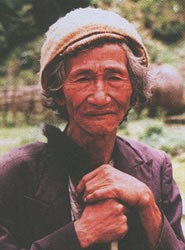

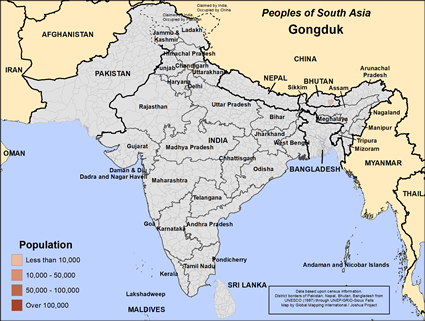
Gongduk people live in a few extremely isolated villages in Bhutan's Mongar District. Dutch linguist George van Driem wrote, 'The Gongduk language is spoken by a dwindling population in a remote enclave along the Kurichu [River] in east-central Bhutan.... In May of 1991, I discovered this previously unknown language in a remote portion of Mongar District, where I was conducting a linguistic survey of the country in the serve of the Royal Government of Bhutan.... Gongduk can be reached on foot from Jepzh 'ing, from which it is two or three days' journey to the south. It is also about a two days' journey up from the Manas River in the plains. This accounts for the fact that the Gongduk have remained largely unknown outside of the Gongduk area itself and its immediate environs. '
As van Driem studied Gongduk, he excitedly realized that he had found a unique language that appears to be the sole representative of a branch of the Tibeto- Burman family. Another source has said that Gongduk 'retains the complex verbal agreement system of Proto Tibeto-Burman. It is said to belong to one of the ancient populations of Bhutan.' Part of the reason the Gongduk remained undiscovered for so long is because the people pass themselves off as Kheng when they meet outsiders. Just why they do this is uncertain, as they have their own unique culture and language that is not mutually intelligible with Kheng. Van Driem further notes, 'There are currently just over a thousand speakers of the Gongduk language. According to one legend Gongduk was once long ago a small independent kingdom. The Gongduk themselves repeat that they are of aboriginal Dung lineage, or Dungjüt, and that their ancestors were semi-nomadic hunters.' In these respects, they are similar to the Lhokpu people of Bhutan.
One must wonder how many other small tribes and language groups exist in the hundreds of isolated valleys of the Himalayan Range. The Gongduk may have been one of the earliest people groups in Bhutan, but for uncertain historical reasons they were driven to their present location centuries ago. Bhutan was completely closed off to outside influence for centuries until 1960, when the king allowed more freedom.
Little has changed in rural areas of the nation for centuries. They engage in subsistence agriculture cultivating crops such as maize, millet, and vegetables, working small plots of land that are often situated on steep hillsides. Families depend on these gardens for their daily food supply, and much of their labor is focused on planting, tending, and harvesting according to the seasons. In addition to farming, they may keep livestock such as cattle or goats, which provide milk, meat, and support for agricultural work. Their economic life is largely self-sufficient, with limited involvement in broader markets due to their remote location.
Men and women share responsibilities within the household, though tasks are often divided. Men typically handle heavier labor such as clearing land and managing animals, while women are closely involved in planting, food preparation, and caring for children. Cooperation within the family is essential, and extended families often work together in both agriculture and daily responsibilities.
For recreation, the Gongduk people enjoy activities that strengthen community relationships and reflect their cultural heritage. Social gatherings are an important part of life, especially during seasonal events or local celebrations. During these times, people come together for singing, dancing, and storytelling, which serve both as entertainment and as a way of passing on tradition. Music and rhythmic movement are particularly valued, and communal participation reinforces a shared identity.
In addition to organized gatherings, recreation is often simple and relational. Visiting with neighbors, sharing meals, and participating in informal conversations are meaningful ways people relax and maintain strong social bonds. These interactions reflect a way of life where community and personal connection are central, and leisure is woven naturally into the rhythms of daily living.
The religious belief of the Gongduk is Tibetan Buddhism mixed with animistic spirit worship. Throughout two thousand years of Christianity, the good news that Jesus Christ died for the sins of the world has never once entered the remote enclave inhabited by the Gongduk.
The Gongduk people need all kinds of infrastructure improvements. They need modern hospitals and schools.
Pray for the Gongduk people to have hearts that are open to the abundant blessings of Jesus Christ.
Pray for their families to prosper financially and spiritually as they experience a relationship with Jesus Christ.
Pray for a disciple-making movement among the Gongduk that will spread joy, peace and salvation to other peoples in Bhutan.
References
Scripture Prayers for the Gongduk in Bhutan.
| Profile Source: Joshua Project |



