




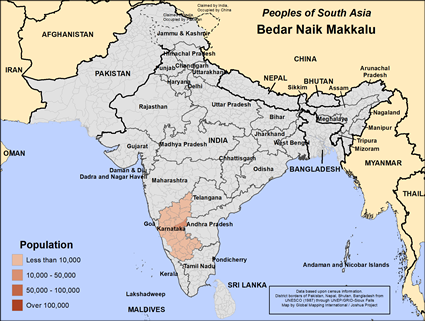
The Naik Makkalu Bedar are a community found primarily in the southern Indian state of Karnataka. They are associated with the broader Bedar or Valmiki social groups, many of whom historically lived as hunters, forest workers, guards, warriors, or agricultural laborers. Over time, changing political systems and modernization led many Bedar communities to settle permanently in villages and towns where they adapted to farming and wage labor. The term "Naik" has historically been linked with leadership or military responsibility in parts of South India.
The Naik Makkalu Bedar speak Kannada, the dominant language of Karnataka. Their identity is shaped by regional customs, clan ties, and long-standing traditions connected to rural life. Though modern education and migration have influenced younger generations, many families still maintain close connections to village culture and traditional social structures. In some areas, they remain economically vulnerable and socially marginalized compared to more established urban communities.
Many Naik Makkalu Bedar families live in rural or semi-rural settings where agriculture, daily wage labor, construction work, transport services, and small-scale trade provide income. Some work as farmers cultivating crops common to Karnataka, while others migrate temporarily to cities for employment opportunities. Economic stability often depends on seasonal work and local conditions.
Family and community relationships are very important. Extended families frequently live near one another, and village life commonly revolves around festivals, marriages, and religious gatherings. Elders are generally respected, and family honor plays a significant role in social decisions. Traditional foods often include rice, millet, lentils, vegetables, and locally available meats depending on regional practices and religious background.
Modern influences such as mobile technology, education, and urban employment are gradually changing the lifestyle of younger generations. Even so, many communities continue to experience limited educational opportunities, unstable income, and uneven access to healthcare and infrastructure. Rural isolation in some areas can also reduce access to broader economic advancement.
The Naik Makkalu Bedar are primarily Hindu and commonly participate in regional folk religious traditions alongside mainstream Hindu practices. Worship may include devotion to village deities, ancestral spirits, protective gods, and regional Hindu gods and goddesses. Religious life is often shaped by local customs, temple rituals, seasonal festivals, vows, offerings, and ceremonies connected to family or village wellbeing.
In many communities, folk religion and animistic practices exist alongside Hindu belief. Fear of spirits, curses, evil influences, and the need to appease local deities may strongly influence daily life and decision-making. Ritual specialists or local spiritual figures may be consulted during sickness, family problems, or times of crisis.
Although some may identify culturally with Hinduism, many have little understanding of the gospel of Jesus Christ or the biblical teaching of salvation by grace through faith. They need to hear that forgiveness of sins and reconciliation with God come through Christ alone rather than through rituals, offerings, or religious observances.
The Naik Makkalu Bedar need greater access to the gospel in culturally understandable forms and through believers willing to live among them with humility and compassion. In many places there are few strong Christian fellowships nearby, and social pressure can discourage open interest in Christianity. Those who become followers of Christ may face misunderstanding from family or community members.
Practical needs also remain significant. Many communities face economic uncertainty, inconsistent employment, limited educational advancement, and inadequate healthcare access. Rural poverty and social marginalization can contribute to cycles of hardship that affect younger generations.
There is a need for faithful Christian workers who can build long-term relationships, provide biblical discipleship, and demonstrate Christ's love through practical service. Scripture resources and Christian teaching in Kannada are important so that believers can grow in spiritual maturity and share the gospel with others in their own communities.
Pray that the Naik Makkalu Bedar people will hear the gospel clearly and respond in faith to Jesus Christ.
Pray that God will raise up mature Christian workers who are willing to serve among the Naik Makkalu Bedar with wisdom, patience, and genuine love.
Pray that the Naik Makkalu Bedar will be adopted through the People Group Adoption program so that churches and believers will commit to ongoing prayer and future gospel outreach among them.
Pray that any existing believers among the Naik Makkalu Bedar will grow strong in biblical truth and boldly share Christ with neighboring families and communities.
Scripture Prayers for the Bedar Naik Makkalu in India.
https://en.wikipedia.org/wiki/Bedar
https://en.wikipedia.org/wiki/Kannada_people
https://en.wikipedia.org/wiki/Karnataka
| Profile Source: Joshua Project |




