


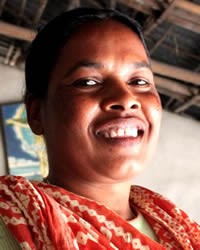

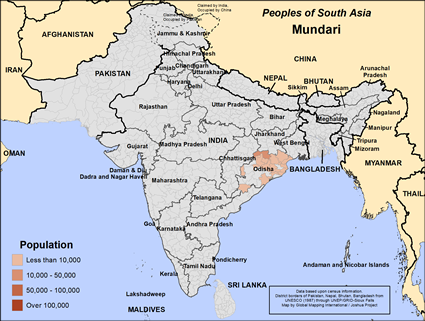
Racially the Mundas (aka, Mundari) are proto-Australoid. They have their own language, Mundari, and they live in Odisha, in eastern India.
Mundaris used to own and farm their own land, but in recent years many have lost a lot of their land and now are dependent on the meager daily wages they receive when there is work for day laborers. As a result, many Mundaris live day-to-day, waiting to buy their food for the evening until they have received their pay for that day.
The Mundari are primarily rural villagers who depend on farming and the natural environment for their livelihood. They cultivate crops such as rice, maize, and vegetables, and they often supplement their income through forest products, hunting, fishing, and occasional wage labor. Their daily life is closely tied to the land, and the rhythm of the seasons shapes their work and social activities.
What is especially unique about their lifestyle is their strong communal structure and cultural continuity. Their society is organized around clans, and community life plays an important role in decision-making, celebrations, and maintaining traditions. The Mundari place a high value on unity, cooperation, and shared identity, which is reflected in their social customs and village life.
For recreation and enjoyment, the Mundari participate in activities that are deeply integrated into their culture. Festivals are a major source of joy and social life. Celebrations such as Sarhul, Karam, and Sohrai mark important agricultural seasons and are times of communal feasting, singing, and dancing. These events strengthen relationships and provide an opportunity for the whole community to gather together.
In addition to festivals, music and dance are central to everyday enjoyment. The Mundari perform traditional folk dances and songs that express their history, beliefs, and experiences. These activities are not only entertainment but also serve to pass on cultural values and maintain a sense of identity.
Most Mundaris call themselves Hindu, though they may in actuality follow traditional religion. Their religious practices are closely tied to the agricultural cycle and the natural world, influencing how they view life, work, and community. Nominalism is prevalent among the few Munda Christians, and an evangelical mission could work to meet not only their physical needs but also their spiritual needs.
Some major needs of the Mundaris include job skills training and land rights intervention.
Pray for the Lord to raise up Christians to help the Mundaris with needed job skills.
Pray for the Holy Spirit to intervene in Mundari families and villages.
Pray for the Lord to show himself powerful and good, drawing thousands to himself.
Scripture Prayers for the Mundari in India.
Anonymous
| Profile Source: Joshua Project |




