




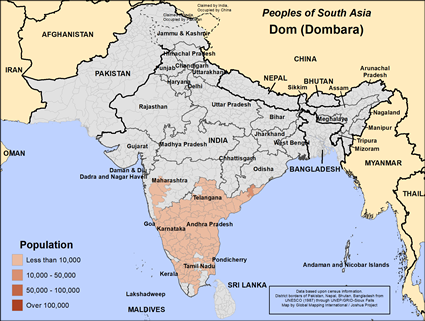
The Dom, also known as Dombara, are a Telugu-speaking community found in parts of India. Their name is associated with traditional drumming, music, and dance, and they have long been known for their energetic performances at festivals, weddings, and public celebrations. Historically, the Dom occupied a low social position within Indian society and were often regarded as untouchables, existing outside the traditional caste hierarchy.
References to Dom communities appear in ancient Indian literature, including certain Tantric writings. For centuries, many Dom families lived in separate settlements and performed occupations that other groups considered undesirable. These duties often included handling animal carcasses, assisting with cremations, and disposing of human remains. Some also served as palanquin bearers and provided musical entertainment for higher-status communities.
During the British colonial period, some Dom groups suffered further discrimination when they were classified under the Criminal Tribes Acts, legislation that unfairly stigmatized numerous marginalized communities. Although many of these legal restrictions were eventually removed, the social effects of historical discrimination have continued to influence the community.
Today, Dom communities are found in several regions of India. While modernization has created new opportunities for some families, many continue to struggle against longstanding social barriers and economic hardship.
The lives of the Dom people vary according to location, but family and community relationships remain central to their identity. Most families live in close-knit neighborhoods where relatives often assist one another with childcare, celebrations, and times of need. Respect for elders is important, and traditional customs continue to shape community life.
Historically, drumming, music, dancing, and other performance arts were among the occupations that gave the Dom their distinctive identity. Musicians often played at weddings, religious festivals, village fairs, and other public gatherings. Their rhythmic performances helped preserve cultural traditions and provided an important source of income for some families.
Many Dom families have also worked in occupations connected to cremation grounds, sanitation, waste collection, recycling, and other forms of manual labor. In some regions, they became known for collecting and selling materials that others discarded. Because of social prejudice associated with these occupations, many Dom have faced exclusion and limited opportunities for advancement.
Today, livelihoods are increasingly diverse. Some work as agricultural laborers, construction workers, small traders, artisans, drivers, or wage earners in towns and cities. Others have pursued education and entered professional occupations. Nevertheless, poverty and limited access to economic opportunities continue to affect many households.
Food habits generally reflect the broader culture of the regions where they live. Rice is a staple in Telugu-speaking areas, often accompanied by lentils, vegetables, spices, and locally available foods. Weddings, religious festivals, and family ceremonies remain important occasions for gathering with relatives and strengthening community ties.
Although modernization, urban migration, and education have brought change, many Dom families continue to maintain a strong sense of cultural identity rooted in their history, occupations, and community traditions.
The Dom people primarily follow Hinduism. Like many Hindu communities, their religious life includes devotion to various gods and goddesses, participation in temple worship, and observance of religious festivals throughout the year.
Their beliefs often combine mainstream Hindu practices with local folk traditions. Many seek blessings, protection, health, and prosperity through rituals, offerings, and prayers. Hindu festivals such as Holi, Diwali, Navratri, and Rama Navami are commonly observed and provide important opportunities for family and community participation.
While Hindu philosophy can be highly diverse, many Dom people encounter religion through practical rituals, local traditions, and community observances rather than formal theological study. Very few have had a meaningful opportunity to hear and understand the gospel of Jesus Christ in a way that connects with their cultural background.
The Dom people face both spiritual and practical needs. Generations of social marginalization have contributed to challenges related to education, employment, and social acceptance. Many families would benefit from improved educational opportunities, vocational training, healthcare services, and pathways to economic stability.
Spiritually, the Dom remain among the least-reached communities of India. Although Scripture and Christian resources exist in their primary language, many have never personally encountered a follower of Christ who can explain the gospel in a culturally meaningful way. They need faithful Christian workers who will serve them with humility, compassion, and long-term commitment.
The Dom need opportunities to discover their true worth and dignity as people created in the image of God and to hear the message of salvation through Jesus Christ.
Pray that the Dom people will be adopted through the People Group Adoption program so that sustained prayer, intentional engagement, and future gospel ministry will reach their communities.
Pray that Christians will build loving relationships with the Dom and boldly share the good news of Jesus Christ in ways that are understandable and culturally relevant.
Pray that many Dom men, women, and children will develop a deep spiritual hunger that leads them to seek Jesus Christ and follow Him no matter what the cost.
Pray that God will provide improved healthcare, education, sanitation, employment opportunities, and other practical resources that will strengthen Dom families and communities.
Scripture Prayers for the Dom (Dombara) in India.
https://en.wikipedia.org/wiki/Dom_(caste)
https://en.wikipedia.org/wiki/Domba_people
| Profile Source: Joshua Project |




