


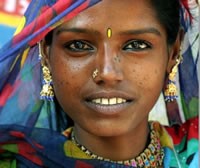

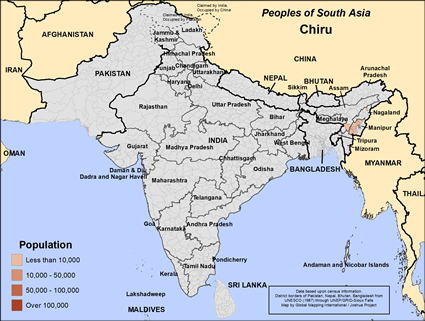
The Chiru people are an indigenous tribal group primarily residing in the northeastern Indian state of Manipur, with some communities in Assam and Nagaland. They speak the Chiru language, which belongs to the Tibeto-Burman family. Traditionally, the Chiru have lived in small, close-knit villages nestled in the hills, maintaining a distinct identity among the many ethnic groups of the region. Their oral history traces their origins to ancient migrations across the Indo-Burmese borderlands, and their culture has been shaped by centuries of interaction with neighboring tribes and the broader Manipuri society. The Chiru have faced challenges related to land rights, displacement, and the pressures of modernization, but they continue to preserve many of their traditional customs and social structures.
The Chiru are primarily subsistence farmers, cultivating rice, beans, corn, millet, and a variety of vegetables on terraced hillsides. Livestock such as pigs, chickens, and mithuns (a type of cattle) are important for both food and cultural ceremonies. Women play a significant role in the economy by weaving textiles and crafting bamboo and cane goods, which are sold in local markets for supplemental income. Hunting and fishing, once common, have declined due to environmental restrictions and changing lifestyles.
Chiru villages are organized around extended families and clans, with elders holding respected positions in decision-making. Marriages are typically arranged with the consent of both families, involving the exchange of bride prices and communal feasts that reinforce social bonds. Festivals and communal work, such as building houses or harvesting crops, are important aspects of village life.
They value education, but seldom have access to it, especially in remote areas. Many young Chiru migrate to urban centers in search of better opportunities, though they often face challenges due to limited education and job skills. The community is experiencing the effects of globalization, which brings both opportunities and threats to their traditional way of life.
Most Chiru today identify as Christian, a result of missionary activity in the 20th century. Churches play a central role in community life, and Christian festivals are widely celebrated. However, many Chiru continue to observe elements of their traditional animistic religion, which includes reverence for ancestral spirits, nature deities, and the practice of rituals to ensure good harvests and protection from harm. This blending of beliefs sometimes leads to syncretism, where Christian and traditional practices coexist.
The Chiru's spiritual worldview emphasizes harmony with nature and respect for elders and ancestors. While Christianity has brought significant changes, especially in moral and ethical outlooks, the process of spiritual transformation is ongoing, and there is a need for deeper discipleship and biblical teaching.
joshuaproject.net favicon
joshuaproject.net
The Chiru need ongoing discipleship and biblical teaching to deepen their faith and address syncretism. Improved access to quality education is crucial, especially for children and youth in remote villages. Sustainable development projects, vocational training, and support for traditional crafts can help address poverty and unemployment. The Chiru face challenges related to land ownership and displacement. Legal support and advocacy are needed to protect their rights. Access to healthcare services is limited, and there is a need for better medical facilities and health education. As younger generations move to cities, efforts to preserve the Chiru language, music, and traditions are important for maintaining their identity.
Pray for spiritual revival and a deepening of faith among the Chiru, that they would experience the transforming power of the gospel.
Ask God to raise up strong Christian leaders and teachers who can disciple others and address syncretism in a culturally-sensitive manner.
Pray for improved educational opportunities and for young people to have hope and vision for their future.
Intercede for justice and protection regarding land rights and for wisdom for community leaders facing external pressures.
Pray for holistic development—spiritually, economically, and physically—so that the Chiru may flourish as a people.
Pray for effective outreach to neighboring Buddhist and Hindu communities, that the love of Christ would be made known through the Chiru church.
Reference
AI generated by Gospel Flow
Scripture Prayers for the Chiru in India.
| Profile Source: Joshua Project |




