


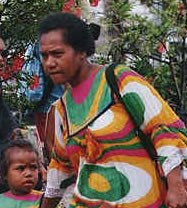

The Detribalized Vanuatu Melanesian in Vanuatu (and Solomon Islands, BP) are people of Melanesian heritage who are no longer closely identified with a single traditional tribal or language group. They are found in both Vanuatu and the Solomon Islands, often in areas where migration, urbanization, and social change have brought together individuals from many different backgrounds.
This identity has developed over time as people moved away from traditional village settings into towns, mission centers, or mixed communities. In these environments, older tribal distinctions became less central, and a broader Melanesian identity emerged. Their history reflects both their roots in diverse tribal cultures and the more recent blending of those identities.
Life for the Detribalized Vanuatu Melanesian often takes place in more urban or semi-urban settings compared to traditional village life. Many live in towns or mixed communities where people from different language groups interact daily. Employment, trade, and access to education may play a larger role in daily life than subsistence farming alone.
Because they come from a variety of tribal backgrounds, there is often a mix of languages spoken. Bislama in Vanuatu and Pijin in the Solomon Islands commonly serve as shared languages, while English may also be used in education, church, and broader communication.
Family life remains important, though extended kinship structures may be less tightly defined than in traditional village settings. Cultural identity is often more flexible, shaped by both Melanesian heritage and the realities of modern life.
The Detribalized Vanuatu Melanesian are identified primarily with Christianity, and churches are widely present in the communities where they live. Many would describe themselves as followers of Jesus Christ, and Christian influence is strong in both personal and community life.
Because they come from varied tribal backgrounds, some individuals may retain elements of traditional belief systems, though these are often less structured than in more isolated village settings. Such beliefs may influence how spiritual matters or life events are understood.
Scripture is generally accessible through widely used languages such as Bislama, Pijin, and English, providing significant opportunity for engagement with God's Word.
A key need among the Detribalized Vanuatu Melanesian is for strong, consistent discipleship that helps believers grow beyond general Christian identity into a clear and personal understanding of the gospel. In mixed and changing environments, faith can easily become shallow without firm grounding in scripture.
Church leaders would benefit from encouragement and sound biblical training to address the challenges of ministering in diverse and transitional communities. Teaching that clearly explains the gospel and applies it to daily life is especially important.
There is also a need for unity among believers from different backgrounds, so that the church reflects the truth of the gospel across cultural differences.
Pray that the Detribalized Vanuatu Melanesian would grow in a deep and personal relationship with Jesus Christ, firmly grounded in Scripture.
Pray for church leaders to be strengthened, equipped, and faithful in teaching God's Word in diverse communities.
Pray for unity among believers from different tribal and cultural backgrounds.
Pray that scripture in widely understood languages would be read, understood, and applied in daily life.
Pray for strong discipleship so that faith is not shallow but rooted in the truth of the gospel.
Scripture Prayers for the Vanuatu Melanesian, Detribalized in Vanuatu.
| Profile Source: Joshua Project |



