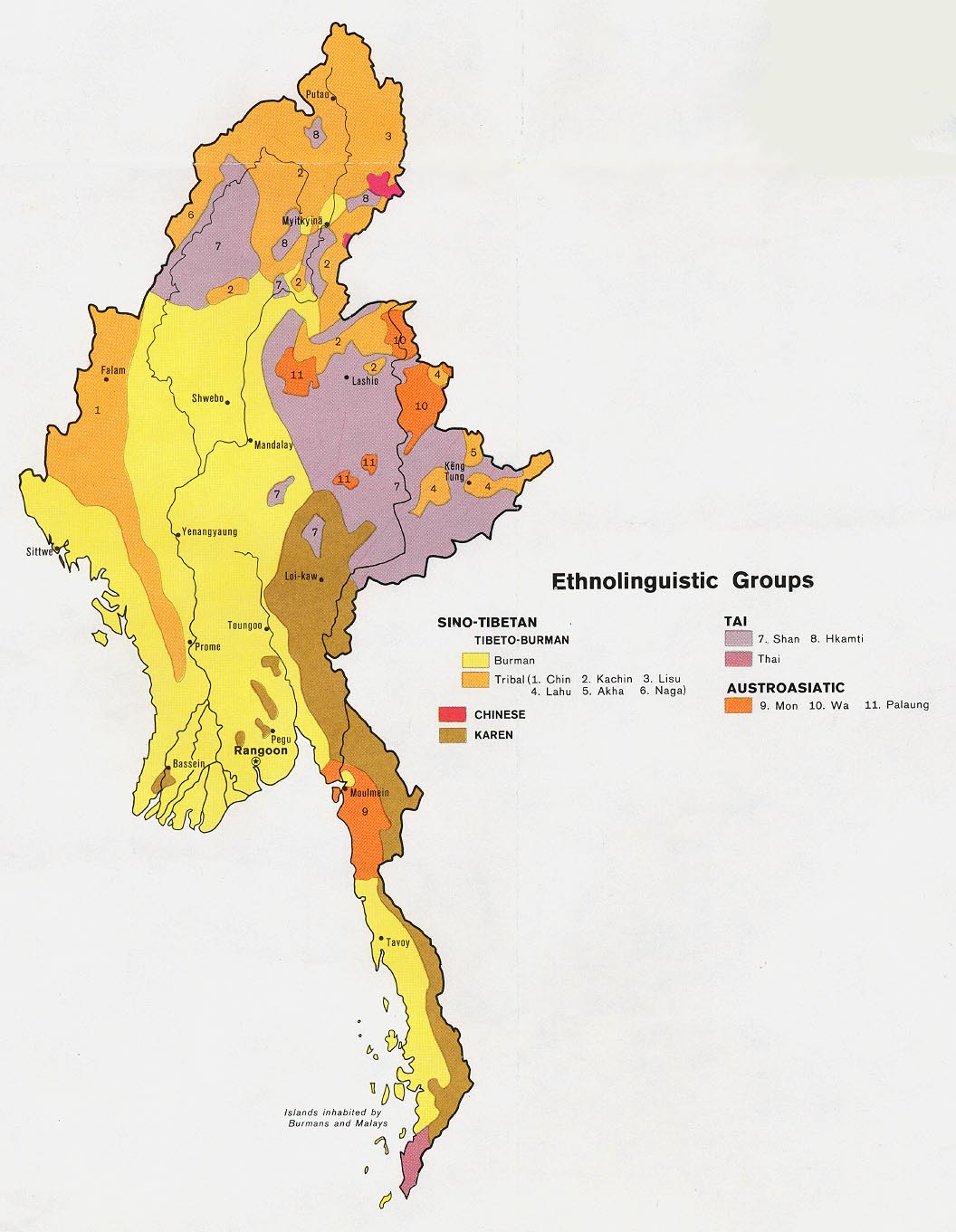

Boasting a large population of around two million people in India, the Meitei dominate the state of Manipur, which means "land of jewels." Meitei people also live in Myanmar, concentrated in the northeast Mandalay Region and parts of five other states. Others live in Bangladesh, where they are officially labeled the "Monipuri" ethnic group.
Strangely, most sources today do not list the Meitei people in Myanmar, even though they have a long and distinguished history there and retain their own customs, language, and identity. The Burmese know them as the Kathe, named after the war horses, they used in battles centuries ago. Since the 1960s, the Meitei have had little contact with their homeland in Manipur. Although the proud Meitei vehemently deny a tribal connection, other groups in Manipur say the Meitei were originally "a hill community who overran the valley and settled there. Their king, on his installation, wore a traditional costume very like that of the neighboring Nagas."
The Meitei language, which is part of the Tibeto-Burman family, consists of two tones, 25 consonants, and six vowels. Despite the Ethnologue not even listing the Meitei language in Myanmar, a 2015 article noted: "While most Meitei in Mandalay speak their mother tongue, they don't have the opportunity to study it…. As the medium of instruction in schools and colleges is Burmese, students must speak in Burmese. The only place to speak Meitei is at home."
The presence of today's Meitei community in Myanmar is the result of a series of brutal wars between Manipur and the Burmese between 1717 and 1749, sparked by the Meitei pretending to offer a princess in marriage between the two royal families. Instead, they "captured 300 Burmese lords and ladies who had come to receive the supposed princess, taking them captive to Manipur." This deception launched a series of revenge attacks that devastated the region, and the Meitei in Myanmar today are the descendants of prisoners of war taken from Manipur three centuries ago. The Meitei in India took on the might of the British military in 1890 but were subdued by superior weaponry. For the next half century, the Meitei were diminished, but an ideological movement emerged in the mid-1950s in a bid to restore their dominance to pre-British levels. This soon created ethnic conflict with the Kuki Chin and Naga tribes in Manipur, which has left thousands dead.
The Meitei have a rich and unique culture stemming from their pre-Hindu past, including traditions of art, dramatic performances, and classical dance. The Meitei in Myanmar seem trapped between their present reality and their past in India. Many feel "cut off from their culture and identity, with Meitei elders fighting a losing battle to preserve their roots in their foster land."
Sanamahism, the original Meitei religion, is still widely practiced today. It feature the worship of Lainingthou Sanamahi, the son of a supreme god and goddess.8 Although the Meitei nominally converted to Hinduism in the 18th century, the religion was laid over their traditional faith. The 1931 census of Burma listed 70. % of Meitei people as Hindus, with only 30 individuals identifying as Christians. Since that time the number of Christians has remained at only about one percent, but many Meitei have converted to Buddhism to fit into Burmese society. A small number of Muslims and animists are also found among them.
The first missionary among the Meitei in India was a young Englishman, William Pettigrew, who came to Manipur in 1890. The British authorities didn't want to antagonize the Meitei, and he was compelled to leave after just six months. Pettigrew refused to give up, and 26 years later he planted a Baptist church in Manipur with 18 members, including a handful of Meitei. 0 Recent decades have seen the gospel progress among the Meitei in India, with a tribal evangelist in 1992 claiming to have established over 74 churches among the Meitei.
Pray for the Holy Spirit to give the Meitei people teachable and understanding hearts.
Pray that a strong movement of the Holy Spirit will bring entire Meitei families into a rich experience of God's blessing.
Pray for Meitei families to be drawn by the Holy Spirit to seek forgiveness, and to understand the adequacy of Christ's work on the cross.
Pray for teams of believers to do sustained, focused prayer for the Lord to open the hearts of Meitei family leaders to experience God's blessing through a movement of family-based discovery Bible studies.
Scripture Prayers for the Meitei in Myanmar (Burma).
Asia Harvest, Copyrighted 2026 © Used with permission
| Profile Source: Joshua Project |
| Other PDF Profile |