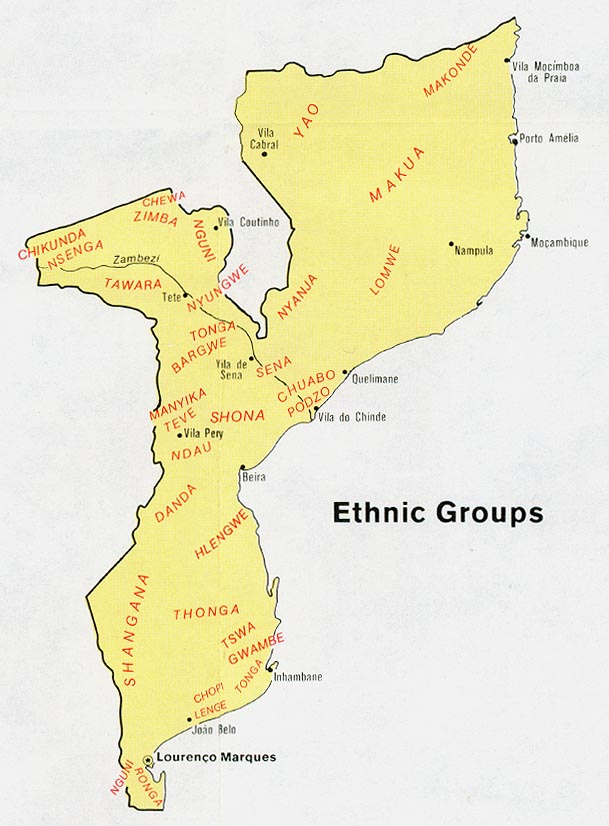
The Senji are an ethnolinguistic group—closely related to the Shona and Ndau peoples—who primarily reside in central and southern Mozambique. Historically, their story is deeply intertwined with migration, shifting regional empires, and the blending of traditional customs with outside belief systems. The Senji trace their roots to the broader Bantu migrations that populated the Zambezi River valley and surrounding plateaus. They are classified under the broader Bantu Shona cluster and speak the Ndau language. Culturally, they have strong kinship ties and a society organized around extended family structures. For centuries, their ancestors were subsistence farmers and agriculturalists, cultivating crops like maize, cassava, and millet. Additionally, they are characterized by religious syncretism which centers around deep reverence for ancestral spirits and animism. However, over centuries of interaction with Swahili traders along the Indian Ocean coast and later European colonists, the Senji began to blend these traditional African practices with Islam and Christianity. Today, while many identify as Christian or Muslim, traditional spiritual practices and tribal customs remain a significant part of their cultural identity.
They face severe poverty, relying largely on rural, subsistence farming and traditional cultural practices.
Living conditions among the Senji are defined by several key areas of daily life. Most are subsistence farmers growing staples like maize, cassava, millet, leafy greens, and beans. Along the river valleys, many also fish or participate in regional migrant labor to supplement their income. Society revolves around strong extended family networks. Because the region is hot and humid, traditional clothing is light and adapted to the climate, though there is a strong cultural emphasis on covering the legs for modesty. The Senji face systemic hurdles including limited access to modern healthcare, clean water, and formal education. There are low literacy rates and few opportunities for economic advancement out of the agricultural sector
Ancestral spirits act as vital intermediaries between the living and the supreme spiritual realm. The Senji routinely offer prayers and recognition to the vadzimu during critical life-cycle milestones, including births, weddings, and funeral rites. Their worldview rejects the separation of the secular and the spiritual. The environment is considered alive with spirits. Natural landmarks—such as forests, mountains, and lakes—are treated with reverence, receiving frequent prayers and physical offerings. Many Senji practice Zionism, an African Instituted Christianity. This faith integrates biblical text with traditional exorcism and healing. Practitioners invoke the Holy Spirit as a localized, powerful force to combat illness and counter malicious spiritual influences. Because Senji culture lacks a history of formalized written scripture, religious dogma, rituals, and historical worldviews are preserved and transmitted strictly through oral storytelling.
Daily life for the average Semji is tough. They make their living where and how they can. Because of Mozambique's natural beauty and attractiveness to tourists (especially water sports and fishing enthusiasts), some of those activities involve catering to the needs of the people who visit there. Despite all their hardship, the people come across as being open, friendly, happy people who have a lot of artistic talent and ingenuity (many running small informal businesses to support themselves). They seem to carry themselves with dignity and grace.
Poverty is a curse for the Senjis. Most are subsistence farmers with little or no chance for an education, which would give them the opportunity to open new economic doors. With food insecurity and malnutrition surging, farmers and fishers are struggling to recover as resources dwindle and coping mechanisms are eroded. Urgent action is critical to help these communities restore their ability to produce food and break free from prolonged reliance on aid.
Pray for the Holy Spirit to bring a powerful revival to Senji churches and those nearby.
Pray for the Lord to raise up disciplers who will make more disciples among the Senji community.
Pray that soon Senji disciplers and evangelists will go to those trapped in religion.
Pray for the Lord to give them an abundant harvest as proof of his goodness and power.
Scripture Prayers for the Senji in Mozambique.
https://notesfromafrica.wordpress.com/2011/05/17/daily-life-in-mozambique-hardship-and-happiness/
https://openknowledge.fao.org/server/api/core/bitstreams/280a5b5d-6a5f-4f52-b911-0c956b1a3f13/content
https://www.wisdomonline.org/prayer/mozambiqu
| Profile Source: Joshua Project |