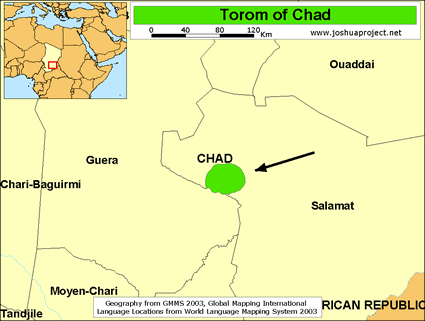

The Torom are a Chadic ethnic group in Chad. They speak Toram, a language from the Chadic branch of the Afro-Asiatic family, and live in the central Batha region, near Lake Fitri. Their ancestors settled in this semi-arid savanna area centuries ago, forming small communities based on farming and herding. The Torom maintained local alliances amid larger kingdoms like Bagirmi and Ouaddaï, which influenced trade and conflicts. French colonial rule in the early 1900s introduced new administrative structures and labor demands, but the Torom preserved their traditions. After Chad's independence in 1960, they faced droughts, civil unrest, and economic shifts, yet continued to uphold clan-based leadership and cultural practices in rural villages.
Torom people reside in compact villages with homes made of mud bricks and thatched roofs, suited to the dry climate. Most work as farmers, cultivating millet and sorghum on small plots, while men herd goats and cattle to supplement income. Women manage household gardens, process grains, and trade at weekly markets. Family dynamics emphasize extended clans, where polygamous households are common and elders resolve disputes and arrange marriages to strengthen ties. Children contribute to chores from a young age, learning skills like weaving and animal care. Celebrations include harvest festivals with drumming, dances, and storytelling, as well as weddings featuring bridewealth exchanges and communal songs. Food revolves around boule, a thick millet porridge eaten from a shared bowl with peanut or okra sauces, dried fish, and greens. On special days, they prepare grilled goat or lamb with spices, accompanied by hibiscus tea.
The Torom practice Sunni Islam, shaped by regional traditions. Daily life includes mosque prayers and observance of Ramadan, with community imams leading rituals. Ancestral spirits play a role in their faith, honored through offerings at sacred sites for protection and good fortune. Diviners use herbs and charms for healing and guidance, blending Islamic teachings with local customs. Moral stories from the Koran guide family and village harmony, passed down orally by elders.
Clean water access is limited in the Batha region, forcing long walks that strain families and increase health risks from contaminated sources. Basic healthcare is scarce, leaving many exposed to diseases like malaria without nearby clinics or medicines. Better seeds and irrigation tools would boost crop yields amid frequent droughts.
Pray for Torom communities to encounter Jesus Christ through dreams, visions, and bold witnesses, leading to vibrant churches.
Pray for reliable rains and productive farms to ease hunger and support family stability in dry seasons.
Pray for strong marriages and wise elders to nurture youth in faith and cultural values.
Pray for literacy programs in Toram that include Scripture, empowering believers to share the gospel widely.
Scripture Prayers for the Torom in Chad.
https://www.peoplegroups.org/Explore/groupdetails.aspx?peid=11462.
https://www.ethnologue.com/language/trj.
https://www.britannica.com/place/Chad/Ethnic-groups.
https://www.everyculture.com/Bo-Co/Chad.html
| Profile Source: Joshua Project |