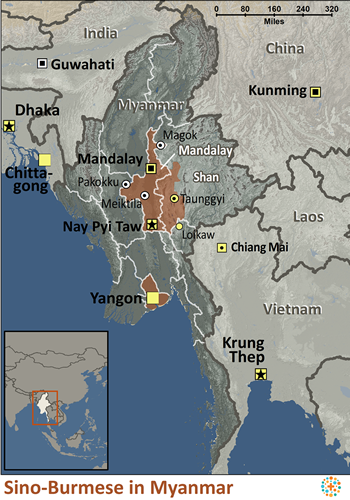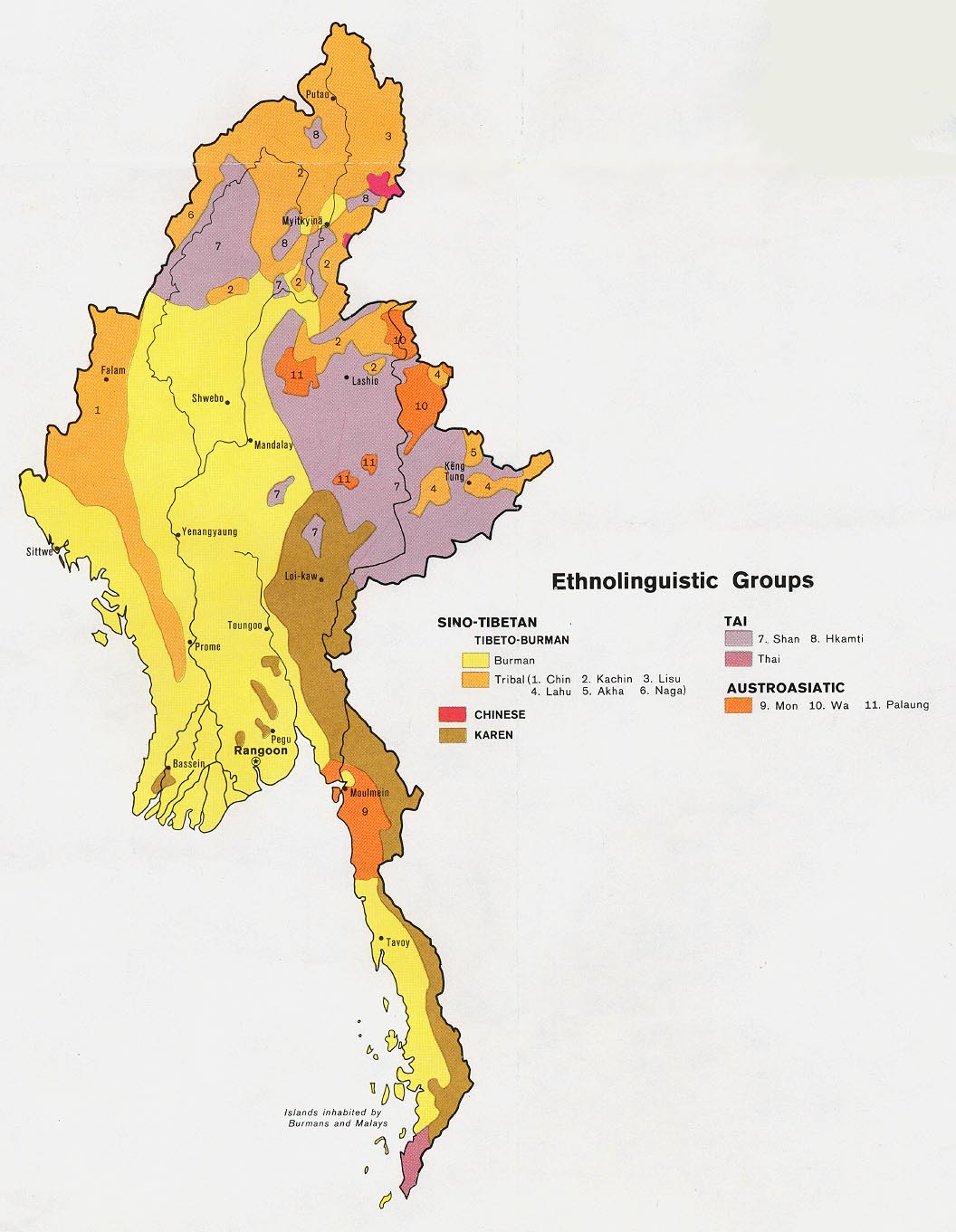

The Sino-Burmese live across a widespread area of Myanmar, with communities in the nation's major cities and in towns and villages along the Chinese border in Shan and Kachin states. Sino-Burmese communities have emerged in other parts of the world, with 40,000 in Taiwan (primarily in the Zhonghe District near Taipei), and others in Macau, Hong Kong, Singapore, the United States, and Australia.
This profile refers to a special, mixed people group, the Sino-Burmese, and not to the five Han Chinese language groups who together number more than 1.3 million people in Myanmar. Those groups have been profiled separately in Operation Myanmar. The Sino-Burmese are an ethnic group of half-Chinese and half-Burmese people, usually resulting from unions between Chinese men and Burmese women. Most Sino-Burmese people adopted local culture and have generally blended into Myanmar society. Although much of their history has been characterized by conflict and tensions between China and Myanmar, "In the 1940s and 1950s, the term paukphaw ("sibling") was co-opted as an affectionate term for the Chinese and is now typically used in the context of diplomatic ties between China and Myanmar. The term itself originates from a Burmese myth about the Chinese and Burmese peoples as being descendants of the same parents, a dragon princess and a sun god."
Globally, children of mixed marriages have tended to adopt the language spoken by their mothers, and today Burmese is the preferred spoken and written language of the Sino-Burmese people. Many children are educated in Burmese-language schools and are influenced by local media. While many people in the border areas can speak Mandarin, other Sino-Burmese people have no knowledge of Chinese.
Records suggest the first Chinese people migrated to today's Myanmar during the Song Dynasty (960-1279). In the 18th century, "Chinese traders traveled as far as the capital city as well as to northern towns on the?Ayeyarwady?River, such as?Bhamo. Some of them stayed and started a Chinese community at?Amarapura, and when King?Mindon?moved his capital to?Mandalay?in 1859, the Chinese were the only community that decided to stay behind. Many of their descendants intermarried into the host society and remain important and respected citizens of Amarapura." During the British colonial era, questions arose regarding the status of Sino-Burmese mixed marriages, but the High Court of Burma settled the issue by recognizing the rights of Sino-Burmese people.
Despite China's emergence as an economic superpower, many Sino-Burmese families in Myanmar have struggled. During the Burmese property boom of the 1990s, "Chinese real estate investors began building and speculating as property values doubled and tripled, which resulted in indigenous Burmese being pushed further away from their native homes and displaced into the outskirts of major Burmese cities towards impoverished shantytowns…. The increased economic clout held in the hands of the Chinese in Myanmar has triggered distrust, envy, resentment, and anti-Chinese hostility among the indigenous Burmese majority."
Almost all Sino-Burmese people in Myanmar are Buddhists, blending in with the dominant ethnicities. Few have ever become Christians compared to some of the other Chinese-speaking groups in Myanmar, as identifying as Buddhists has become a key part of the Sino-Burmese community's struggle to be recognized as an indigenous people group.
Although the Sino-Burmese have been viewed as a distinct group for over a century, little Christian outreach has ever been launched to reach them. A 1917 mission book lamented that among all Chinese-related people in Yangon, "just two regular Methodist workers are among them, and some Baptist work is sustained by the Rangoon City Mission Society; as much effort as possible through the imperfect channel of the Burmese language." Today, a mere one percent of Sino-Burmese people are estimated to be followers of Jesus Christ in Myanmar.
Pray for the Lord to raise up a strong movement to Christ to saturate the hearts and minds of the Sino-Burmese people.
Pray for God's blessing, strengthening and healing of Sino-Burmese families and communities within this people group through the abundant life Jesus offers to all who call on his name.
Pray for God's blessing on the leaders in this people group, along with their families, and for their communities to welcome and enjoy God's blessing.
Pray for the Lord to multiply the reception and influence of his word among this people group, leading them to love him with their whole being.
Scripture Prayers for the Sino-Burmese in Myanmar (Burma).
Asia Harvest, Copyrighted 2026 © Used with permission
| Profile Source: Joshua Project |
| Other PDF Profile |