


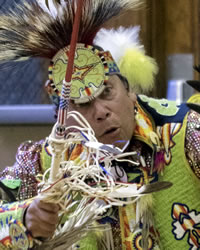

The Oneida — whose name in their own language, Onyota'a:ka, means "People of the Standing Stone" — are a First Nations people of Iroquoian heritage whose ancestral homeland was in what is now central New York State. They were one of the five founding nations of the Haudenosaunee Confederacy, also known as the League of the Iroquois, a sophisticated alliance of Indigenous nations governed by the Great Law of Peace. The confederacy later became six nations when the Tuscarora sought and received shelter among the Oneida in the early eighteenth century.
The Oneida's alliance with American colonists during the Revolutionary War set them apart from most of the other Iroquois nations, who sided with the British. This alliance brought retaliation and displacement rather than security. After years of land loss through broken promises and coercive state treaties that reduced their New York holdings to a fraction of their original territory, a group of Christian Oneida — affiliated with Methodist and Anglican congregations — purchased land along the Thames River in what is now southwestern Ontario and relocated there in 1840. Their settlement, known as the Oneida Nation of the Thames, sits near Southwold in Elgin County, roughly thirty minutes south of London, Ontario.
The Oneida language, a member of the Iroquoian language family, is critically endangered today. Despite active efforts at the community's Oneida Language and Cultural Centre to teach the language to children in local schools, the number of fully fluent speakers remains very small. The community also holds membership in the Six Nations of the Grand River, the larger Haudenosaunee reserve near Brantford, Ontario.
The Oneida Nation of the Thames is a self-governing community with its own elected band council and a parallel hereditary clan council rooted in the traditional Haudenosaunee system of governance. The nation is organized into three clans — Wolf, Bear, and Turtle — and clan mothers continue to hold important roles in guiding community decisions and appointing hereditary chiefs. Community infrastructure includes two elementary schools, a health clinic, a community center, a seniors' rest home, a fire hall, and a community-owned radio station.
Many Oneida today work in the surrounding towns and the city of London, holding jobs in trades, healthcare, education, government, and small business. Several community members operate independent businesses, including craft shops, variety stores, and other enterprises on the settlement. Urbanization has drawn a significant portion of the membership away from the settlement, and the community maintains ties with those living off reserve through events and the band's governance structure.
Food traditions connect the Oneida to their Haudenosaunee heritage. Corn, beans, and squash — the "Three Sisters" of Iroquoian agriculture — remain culturally significant, and traditional foods appear at community gatherings and ceremonies. The annual Oneida Fair, held each September, is a long-standing community celebration that draws members back to the settlement for agricultural competitions, home arts, music, and fellowship. Seasonal ceremonies tied to the Haudenosaunee ceremonial cycle, conducted in the longhouse, mark the rhythms of the year and bring the community together around shared identity and heritage.
Christianity has been the predominant faith of the Oneida of Canada since before their arrival in Ontario. The community's founders in 1840 were affiliated with Methodist and Anglican churches, and these Protestant denominations have shaped Oneida religious life for nearly two centuries. Church attendance and Protestant identity have historically been strong markers of community belonging, and both traditions maintain a presence in the community today.
Alongside Protestant Christianity, the Longhouse religion — a spiritual movement rooted in the early nineteenth-century teachings of the Haudenosaunee prophet Handsome Lake — also has followers within the community. The Longhouse way of life blends traditional Iroquoian ceremonial practices with elements borrowed from Christian moral teaching, including an emphasis on sobriety, honesty, and communal responsibility. The two spiritual streams — Protestant Christianity and the Longhouse way — have coexisted within the Oneida community for generations, and individual Oneida may identify with one, both, or neither in varying degrees.
Like many First Nations communities in Canada, the Oneida face the lasting effects of colonial policies, including intergenerational trauma connected to the residential school era, which is actively being documented and addressed by the Oneida Nation of the Thames through its Residential School Project. Mental health challenges, substance use, and economic vulnerability affect portions of the community and call for sustained and culturally sensitive care. The Oneida language stands at a critical threshold, and its survival depends on urgent investment in speakers, resources, and the next generation of learners.
Spiritually, the Oneida community needs a renewal of genuine, grace-centered faith in Jesus Christ — a faith that goes deeper than Protestant heritage and touches individual hearts with the saving power of the gospel. Oneida believers who have experienced the transforming work of the Holy Spirit are well positioned to carry the good news beyond their own community, bearing witness to the gospel among other First Nations peoples across Ontario and Canada who have not yet believed.
Pray that Oneida Christians will experience a deep, personal renewal of faith in Jesus Christ and be filled with the Holy Spirit's power for witness and service.
Pray that Oneida believers will carry the gospel to neighboring First Nations communities and become an active part of God's mission among Canada's Indigenous peoples.
Pray for healing from intergenerational trauma and for the flourishing of mental health, family stability, and community wholeness within the Oneida Nation of the Thames.
Pray that the Oneida language will be preserved and that Scripture and gospel resources will be made available future generations.
Scripture Prayers for the Oneida in Canada.
https://en.wikipedia.org/wiki/Oneida_Nation_of_the_Thames
https://en.wikipedia.org/wiki/Oneida_people
https://oneida.on.ca/about/
https://oneidalanguage.ca/oneida-culture/our-history/
https://www.thecanadianencyclopedia.ca/en/article/oneida
https://www.newworldencyclopedia.org/entry/Oneida_tribe
https://www.everyculture.com/multi/Le-Pa/Oneidas.html
https://www.britannica.com/topic/Oneida-people
https://www.mpm.edu/content/wirp/ICW-57
| Profile Source: Joshua Project |



