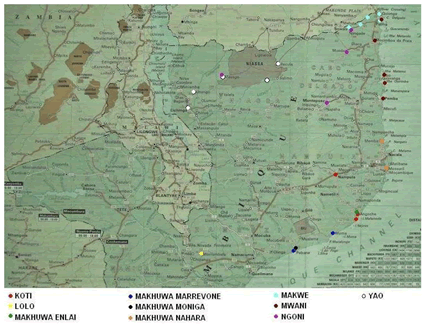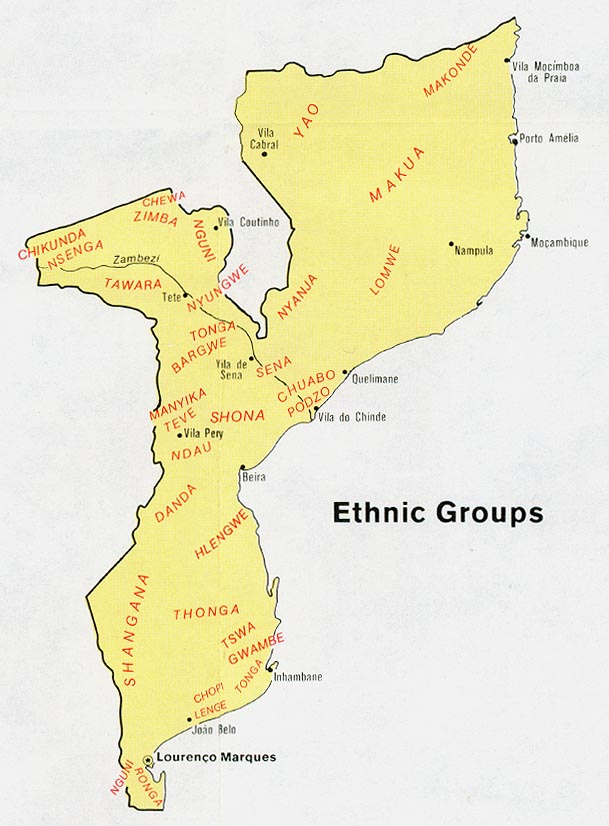

The Makhuwa-Shirima are a subgroup of the wider Makhuwa people, Mozambique's largest indigenous ethnic group. Residing primarily in the northern provinces of Zambezia, Nampula, and Cabo Delgado, their history is characterized by early Bantu migrations, strong agricultural and trading traditions, and deep-rooted cultural resilience. The Makhuwa trace their roots back to the initial Bantu migrations from central Africa. Oral traditions heavily point to the Namuli Mountains in the Zambezia province as their spiritual and ancestral heartland. Over centuries, they transitioned from semi-nomadic hunter-gatherers to stable agriculturalists and pastoralists. Long before European arrival, the Makhuwa were prosperous agriculturalists and traders controlling routes between Lake Malawi and the coast. They traded agricultural products, metalwork, and eventually ivory tusks with Swahili and Gujarati merchants. While inland communities largely held onto their traditional animistic beliefs centered on a creator deity, coastal subgroups heavily adopted the Shafi'i school of Sunni Islam due to prolonged contact with Arab and Swahili traders.
When the Portuguese arrived in 1498, the Makhuwa fiercely resisted colonial incursions into their territories. This resistance continued over centuries as they refused to submit to Portuguese demands or participate in regional slave raids orchestrated by groups like the Yao. Despite their resistance, the broader Makhuwa region unfortunately became heavily embroiled in the 18th- and 19th-century slave trades, with many Makhuwa enslaved and transported globally (including regions like Mauritius and South Africa).
The Makhuwa-Shirima in northern Mozambique live in tight-knit, rural communities, relying on subsistence agriculture and coastal fishing. Deeply rooted in oral tradition and traditional beliefs, their daily lives involve elaborate coming-of-age rituals, rich artistic expressions, and a blend of animism and Islamic practices. A breakdown of their daily life, culture, and social structure highlights several key areas. The Makhuwa-Shirima are primarily agriculturalists. Families cultivate small plots of land, growing crops like maize and beans to sustain themselves, while supplementing their diet with hunting and coastal fishing. Women handle most domestic tasks and form a major part of the agricultural workforce, while men typically engage in fishing, clearing land, and craftwork. Like many Bantu societies in the region, they practice a matrilineal social structure where descent and inheritance trace through the female line. Community life often takes place in small, rural clan-based villages.
Storytelling, music, and proverbs are vital parts of passing down knowledge. For recreation, community members can often be found playing traditional strategy board games—similar to mancala—by carving impressions in the dirt. The Makhuwa are highly skilled craftspeople. Women are well known for making traditional clay cooking pots and weaving colorful, patterned fabric known as capulanas. Men traditionally weave straw mats and produce intricate woodcarvings. Transitioning into adulthood is marked by mandatory and secretive initiation ceremonies (such as Mapiko for males and Unyago for females), which teach adolescents about their future responsibilities as adults.
The Makhuwa-Shirima people of Mozambique practice a highly syncretic belief system that blends traditional animism with Islam and, in some cases, Christianity. Their worldview is deeply rooted in a matrilineal, agrarian culture where ancestral spirits, nature, and the concept of a supreme creator play vital everyday roles. The core beliefs and spiritual practices of the Makhuwa-Shirima include: God as a Mother (Muluku): Traditional cosmology features a supreme, invisible creator deity named Muluku. Because the society is matrilineal, God is frequently conceptualized as a nurturing Mother who continually generates life. They believe natural entities (animals, plants, rivers, mountains) possess spiritual essences. The Makhuwa originate in oral myths tracing to the sacred Mount Namuli, viewing it and its surrounding nature as a spiritual heartland. The dead are regarded as heads of the family who possess additional powers once leaving their physical bodies. Ancestor spirits receive active devotion, prayers, and sacrifices to ensure crop yields, good health, and an untroubled final rest. While traditional spirituality remains the baseline, many Makhuwa-Shirima practice a blend of these indigenous animist beliefs with Sunni Islam. Life passages are governed by specific rituals and taboos. For instance, strict rules exist surrounding pregnancy to avoid mixing "bloods" (iphome), to shield mothers from perceived impurities during menstruation, and to protect against ill-fated outcomes from the spirit world.
The Makhuwa-Shirima in Mozambique face critical needs stemming from extreme poverty, cyclical climate disasters, and armed conflict. Their primary needs include access to food security, modern healthcare, basic education, and peace/stability. Historically, the Makhuwa have been subsistence farmers, but they lack modern tools, relying heavily on traditional hoes and having little livestock. Poverty alleviation and agricultural training are top priorities to improve crop yields and generate income. There is a severe lack of adequate healthcare options in their regions. Pressing health challenges include treating malaria, child malnutrition, HIV/AIDS, and mitigating issues caused by poor sanitation. Because the Makhuwa-Shirima reside in northern Mozambique, they are highly vulnerable to cyclical tropical cyclones, floods, and droughts. Additionally, prolonged armed conflicts in Cabo Delgado have internally displaced hundreds of thousands of people, leaving them in need of safe shelter, clean water, and food aid. There is a strong need for expanded schooling, sports programs, and basic social development to empower youth and increase overall literacy rates.
Ask the Holy Spirit to grant creative ideas of evangelism to the mission's agency that is focusing on the Makua.
Pray for effectiveness of the Jesus film among the Makua, with many turning their hearts to Jesus.
Pray that God will use the Makua believers to share Christ with their own people and with others.
Ask God to raise up prayer teams who will begin breaking up the soil through worship and intercession.
Ask the Lord to bring forth a triumphant Makua church for the glory of his name!
Scripture Prayers for the Makhuwa-Shirima in Mozambique.
https://2009-2017.state.gov/outofdate/bgn/mozambique/40304.htm
https://www.muapulamission.co.za/aboutus.php
https://www.gordonconwell.edu/center-for-global-christianity/wp-content/uploads/sites/13/2020/08/Niassa-Dossier.pdf
https://www.scri
| Profile Source: Joshua Project |