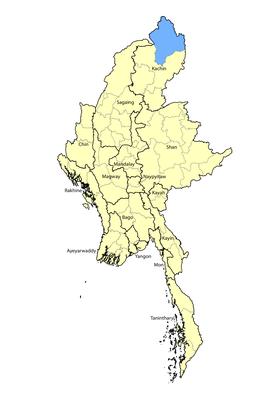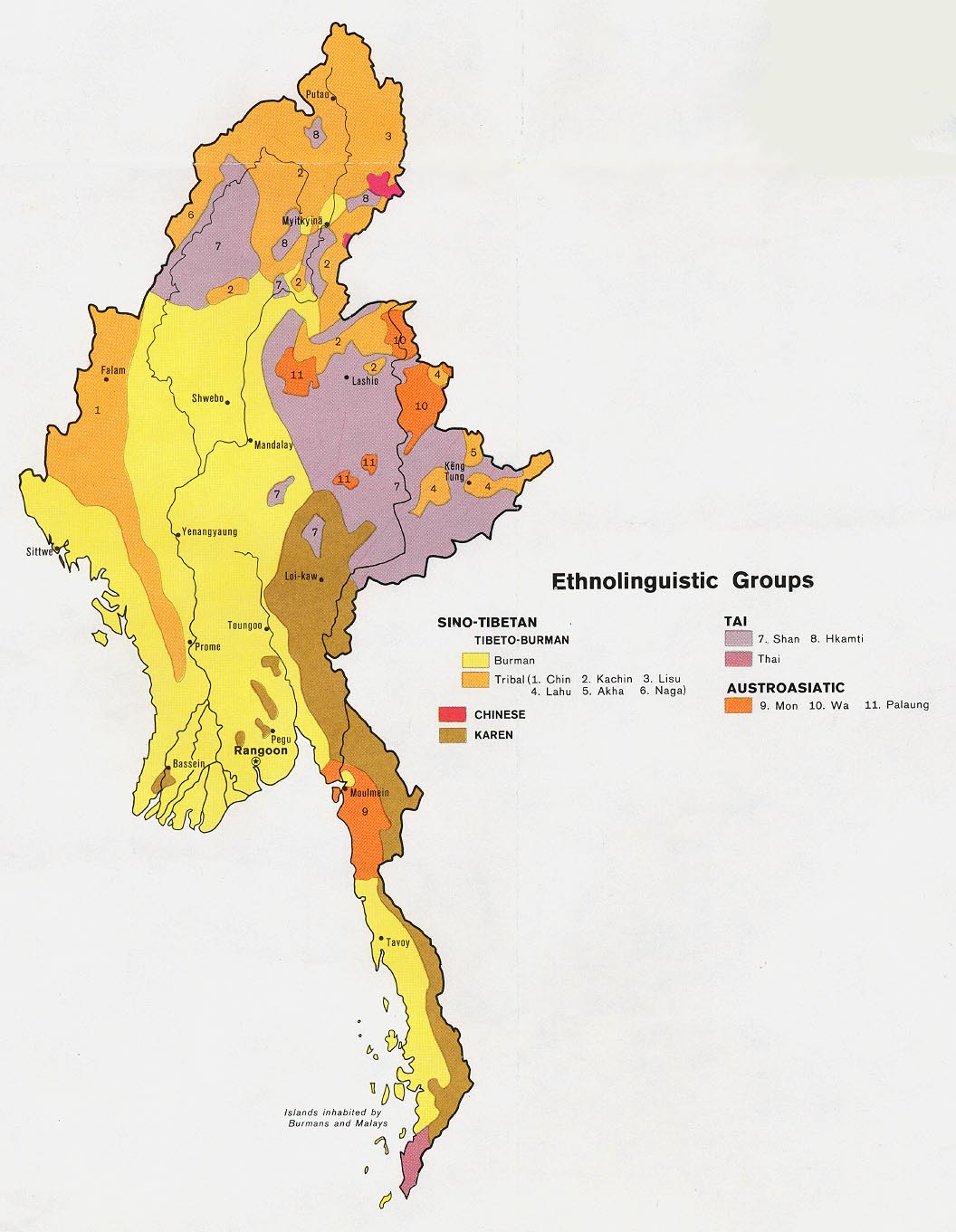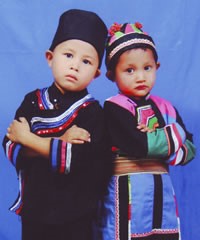

Members of the Black Lisu tribe in Myanmar live in the high mountains of northern Kachin State near where the country's borders meet both India and China. Putao and Myitkyina townships are the main Black Lisu centers in Myanmar. Until the 1930s, the rugged and remote Nujiang Canyon remained a blank area on maps, which even Chinese troops refused to enter. The Black Lisu, who are so named because of the predominant color of their women's vests, differ from other Lisu subgroups in Myanmar. They are considered the most divergent Lisu group due to being isolated in the high mountains. Also called "Highland Lisu," they have retained their own customs, dress, and dialect. The Black Lisu speak their own variety of Lisu. Some Black Lisu speak Kachin Jingpo or Rawang if they live near those groups. Except for Christians who have learned to read the Bible, few Black Lisu can read the unique Lisu script, which was invented by a Karen preacher named Sara Ba Thaw in 1915 and improved by the famous missionary James Fraser before the first Scripture portions were published in 1921. The Black Lisu were hidden away from the world and largely unknown until two British explorers, George Forrest and George Litton, dared to enter their territory in 1905.
Most Black Lisu communities are found in mountain villages where farming remains central to daily life. Families cultivate crops such as rice, corn, vegetables, and fruit, while some people engage in trading, wage labor, or small businesses. Homes are often built from wood and bamboo, although more permanent materials are becoming common in some places. Family ties are strong, and several generations frequently maintain close relationships.
Music, storytelling, and traditional songs play an important role in cultural tradition. Colorful clothing and handmade textiles remain symbols of heritage, especially during celebrations and community gatherings. Seasonal festivals bring families together for meals, singing, and dancing, and important occasions are marked with hospitality and fellowship. Although many aspects of modern life have reached their communities, the Black Lisu continue to value their traditions and communal way of life.
Almost all Lisu who dwell at lower elevations have embraced Christianity, but many Black Lisu still practice animistic rituals. Their traditional religion is said to "combine ancestor veneration with animism and includes gods of earth and sky, wind, lightning, and forest."4 Although estimates are almost impossible to make due to the extreme remoteness of their territory, just over half of Black Lisu people in Myanmar are believed to be Christians today, compared to the larger Lisu group of whom about nine out of ten people are followers of Jesus.
A Christian history exists among the Lisu. Some of the lesser-known missionaries who were greatly used by God include Leonard and Olive Bolton, who impacted the Lisu on both sides of the border in the 1920s and 1930s. They were the first Assemblies of God missionaries to Myanmar. When many of the Lisu in China fled communist atrocities of the 1930s, "they took with them their Scriptures, hymnbooks, and vibrant testimonies and became part of the Myanmar Church."5 A succession of later missionaries helped strengthen the faith of Black Lisu believers, including Clifford and Lavada Morrison, who helped the Lisu churches see the spiritual needs of the Rawang and other unevangelized tribes.
Mountain communities often face challenges related to transportation, education, and access to medical services. Economic opportunities can be limited, causing some families to seek work away from their villages. Greater access to quality healthcare and educational resources would strengthen family life and community development. Churches and believers would benefit from ongoing discipleship, biblical training, and encouragement to deepen their walk with Christ. Mature Christian leaders are needed to equip younger generations and to strengthen the witness of the church. Opportunities also exist for Black Lisu believers to participate more actively in sharing the gospel with neighboring peoples who have little access to the message of Jesus Christ.
Pray for the Lisu people to become ambassadors of Christ, spreading the gospel to unreached peoples in Myanmar.
Pray for increased medical, transportation, and education opportunities for these remote people.
Pray for the Lisu people to have continued discipleship in their lives.
Pray for the Holy Spirit to send revival fire to Lisu churches, blessing them with the power and goodness of Christ.
Scripture Prayers for the Lisu, Black in Myanmar (Burma).
Asia Harvest
1 Summer Institute of Linguistics, Ethnologue: Languages of the World (27th edition, 2024), online version.
2 See "The 1905 British Nujiang Expedition: Into the Land of the Black Lisu" at: https://www.yunnanexplorer.com/features/blacklisu. Forrest's article on the adventure was published three years later: George Forrest, "Journey on Upper Salwin, October-December 1905," Geographical Journal (Vol. 37, No. 3, 1908), pp. 239-266.
3 See https://www.britannica.com/topic/Lisu#ref895740
4 https://www.britannica.com/topic/Lisu#ref895740
5 Chin Khua Khai, The Cross Among Pagodas: A History of the Assemblies of God in Myanmar (Baguio, Philippines: Asia Pacific Theological Seminary, 2003), p. 81. Also see Leonard Bolton, China Call: Miracles among the Lisu People (Springfield, MO: Gospel Publishing House, 1984).
6 A good overview of Assemblies of God outreach to the Lisu is found in Chin, The Cross Among Pagodas, pp. 79-89.
https://www.britannica.com/topic/Lisu
https://www.omniglot.com/writing/lisu.htm
https://www.lisuarchive.com/
https://insightmyanmar.org/all-about-burma/2022/8/26/the-lisu
https://en.wikipedia.org/wiki/Lisu_Christianity
| Profile Source: Joshua Project |
| Other PDF Profile |