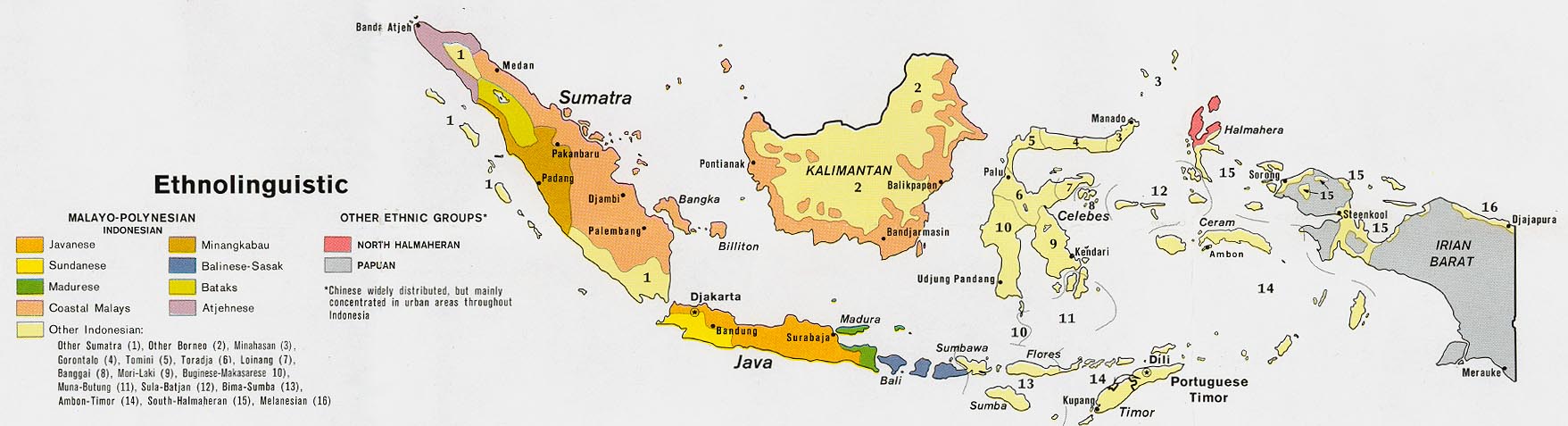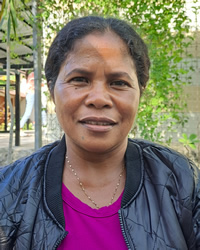

The Kemak people, also known as Ema (or Quémaque), are an indigenous ethnic group living on the north-central region of Timor Island, spanning parts of Timor-Leste and the border regions of Indonesia's province of East Nusa Tenggara. The Kemak language of the Austronesian family is commonly spoken. Historically, the Kemak lived in clan-based social structures organized around ancestral lineages headed by local leaders.
The first Europeans, the Portuguese, arrived in the Timor region in the 16th century declaring the island a Portuguese colony in 1702. In 1867, the Kemak people of the Timor-Leste area rebelled against the more powerful Portuguese colonial masters only to be defeated. After the resistance to them had failed, the Kemak people accepted the leaders of the Portuguese as part of their higher hierarchy that provided them with a larger army, holy men, the Catholic priests and with a larger Lulic (ritual practitioner). Near the end of the 19th century, however, several Kemak empires rebelled against the Portuguese who carried out punitive action. Thousands of Kemak residents fled to the West Timor region, now part of Indonesia.
The Kemak emphasize clan loyalty and respect for elders. Extended families work together in cultivating maize, rice and cassava, as well as raising pigs and chickens. Their subsistence farm life supplies their food which they eat together reinforcing family and community bonds. Women manage household tasks and weave textiles (tais) which they may sell at local markets. In addition to speaking Kemak, many speak regional languages as well as Indonesian enabling interaction with neighboring groups. Music, dance and offerings to spirits often accompany traditional ceremonies that observe harvests, weddings, and ancestral rituals.
The majority of Kemak people are nominally Christian generally identifying as Catholic. Many continue to practice traditional animistic rituals such as offerings to ancestral spirits and nature deities. Funeral rites involve complex ceremonies, including animal sacrifice and a distinct "secondary burial" ritual (cleaning and re-burying bones) — a practice aimed at guiding the spirit of the deceased to ancestral lands on sacred mountains. The traditional practices may be followed by a Catholic mass.
The Kemak people experience limited access to healthcare, clean water and economic opportunities. Their rural communities often struggle with poverty and lack of infrastructure. Socio-economic change related to modernization and resource scarcity challenge traditional agriculture and livestock raising. Culturally, they seek to maintain the Kemak language and oral traditions as vital to their identity. Spiritually, they need discipleship and clear teaching of the gospel, so that faith in Christ can replace reliance on ancestral rituals. Lacking a full New Testament, they need Bible translation and Christian resources in the Kemak language. Evangelical witness is minimal, and many Kemak have not yet heard a clear presentation of the gospel. Local church leaders and clergy may benefit from training and support so that Christian teaching and life in their communities can reflect commitment to Christ rather than nominal syncretism. Their worldview is shaped by fear of spirits and reliance on ritual leaders, leaving them spiritually bound and in need of the freedom found in Christ.
Pray for translation and distribution of a complete Bible (or complete New Testament) into Kemak, so that God's word may be available and understood in the heart language.
Pray that local leaders (village elders, church leaders) will depend on Christ alone to guide their communities in spiritual transformation and unity.
Pray for protection of Kemak cultural identity and language so that younger generations will value and preserve their community and heritage.
Pray for sustainable livelihoods and community development in the face of social change, migration and economic challenges.
Pray that the Kemak people will experience genuine spiritual renewal — that many might move beyond nominal Christianity and traditional syncretism to a living, growing faith in Christ.
Pray that the Kemak people will go and make disciples among their neighbors.
Scripture Prayers for the Kemak in Indonesia.
https://en.wikipedia.org/wiki/Kemak_language?utm_source=chatgpt.com
https://justapedia.org/wiki/Kemak_people?utm_source=chatgpt.com#Other_Kemak_communitie
https://en.wikipedia.org/wiki/Portuguese_Timor
https://seasite.niu.edu/EastTimor/lang
| Profile Source: Joshua Project |