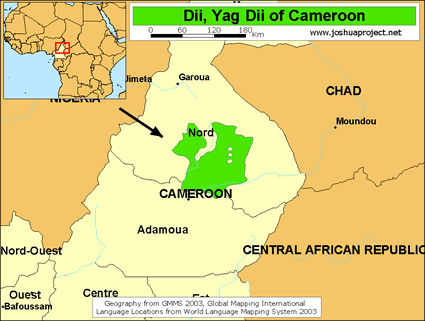
The Dii, also known as the Yag Dii, are a distinct ethnic group living primarily in the northern regions of Cameroon. They are part of the Adamawa-Ubangi people cluster, a classification that reflects their linguistic and cultural connections to broader regional networks across Central Africa. The Dii speak their own language, known as Dii, which serves as the primary means of communication within their communities and is an integral part of their cultural identity.
The history of the Dii people reveals a narrative of resilience and adaptation. Like many ethnic groups in the Adamawa region, the Dii have experienced significant historical movements and shifts. According to historical accounts, the Dii were once centered around the sacred mountain known as Mbang Sii, which held profound spiritual significance in their traditional worldview. However, this settlement pattern changed dramatically through encounters with other powerful groups in the region, particularly the militarily superior Fulbe people who migrated into the area. These encounters prompted the Dii to relocate and reorganize their communities. Subsequently, the arrival of colonial administrations—first German and later French—further shaped Dii settlement patterns and community structures, introducing new systems of governance and requiring further adaptations to their traditional ways of life.
The daily lives of the Dii people are connected to the land and to their extended family networks. Most Dii engage in agricultural pursuits, cultivating crops that sustain both their families and local markets. Like many rural communities throughout Cameroon, agriculture serves as the foundation of their economic life, with farming practices passed down through generations and adapted to the local environment and seasons.
Family structure among the Dii is characterized by strong kinship bonds and extended family ties. The family unit remains the primary social and economic organizing principle, with decisions about marriage, inheritance, and community matters typically addressed within family and clan contexts. Respect for elders and for established social hierarchies is an important cultural value that shapes daily interactions and community governance.
Community life is marked by mutual aid and cooperation. Dii communities often work together on projects of common benefit, and various forms of informal savings and lending arrangements—similar to those found throughout Cameroon—help individuals and families manage financial needs and unexpected hardships.
The Dii people practice Christianity blended with animism as their primary religious worldview. Within this framework, the natural world—including animals, plants, water sources, forests, and even inanimate objects—are understood to possess spiritual essences or forces. This perspective shapes how the Dii interact with their environment and understand the spiritual dimensions of existence.
In the traditional Dii spiritual universe, there is recognition of a supreme God known as Tayyi, who is understood as a distant but organizing force that brings order to society and serves as a safeguard against chaos and disorder. Alongside this belief in a supreme being, the Dii also acknowledge the existence of various spiritual forces and beings that inhabit and influence the physical world. These spiritual entities are understood to have agency in human affairs and to require appropriate respect and acknowledgment.
While traditional animistic beliefs remain the dominant religious framework among the Dii, there is also a growing Christian presence within their communities. Some Dii have embraced Christianity through various missionary efforts, particularly those that date back to work of Norwegian missionaries who began engaging with Dii communities in the 1930s and 1940s. This historical Christian engagement created opportunities for spiritual dialogue and conversion, and today there are Dii believers who integrate Christian faith into their lives alongside or in place of traditional practices.
The coexistence of traditional beliefs and Christianity among some Dii represents an ongoing religious landscape within the group. Many Dii continue to hold to their ancestral animistic beliefs as their primary spiritual orientation, while others have become adherents of the Christian faith.
Access to quality education remains limited in many Dii communities, which constrains opportunities for children and young adults seeking to develop skills and pursue economic advancement beyond subsistence agriculture. When educational opportunities are available, they are often limited in scope and resources.
Healthcare access is another critical concern. Rural communities where many Dii live often lack adequate medical facilities, trained healthcare workers, and reliable access to medicines. This reality leaves communities vulnerable to preventable illnesses and complications from treatable conditions. Maternal and child health, in particular, can be compromised by limited access to professional medical care.
Economic opportunities beyond agricultural subsistence remain scarce in many Dii areas. Agricultural productivity itself can be affected by variable rainfall, soil degradation, and limited access to improved farming technologies or inputs. Young Dii seeking economic advancement often find few alternatives within their home regions, leading to rural-to-urban migration in search of employment and income-generating opportunities.
Infrastructure development—including reliable roads, electricity, and clean water access—remains uneven across Dii territories.
Pray for spiritual awakening among the Dii people, that the gospel would be presented clearly and compellingly to communities and families, and that the Holy Spirit would work mightily in opening hearts to receive the message of salvation and transformation through faith in Christ.
Pray for Christian workers and missionaries who labor among the Dii, that they would have wisdom in cross-cultural ministry, sensitivity to Dii culture and values, perseverance in the face of challenges, and joy in their calling.
Pray also that the Lord would raise up additional laborers from among both the Dii themselves and from other Christian communities called to serve among them.
Pray for Dii believers, that those who have come to faith in Christ would grow in their understanding and practice of the Christian faith, would become bold witnesses to their own families and communities, and would be equipped to lead and disciple others toward faith in Jesus.
Pray for churches among the Dii, that Christ-centered, spiritually vital congregations would be established and would multiply, becoming centers of transformation, community blessing, and ongoing gospel witness.
Pray for the practical needs of the Dii people—for improved access to education, healthcare, economic opportunities, and infrastructure development.
Pray for protection and guidance for Dii youth and young families.
Scripture Prayers for the Dii, Yag Dii in Cameroon.
https://www.sil.org/resources/publications/entry/7906
https://www.researchgate.net/publication/344664548_Communication_and_Conversion_in_Northern_Cameroon_The_Dii_People_and_Norwegian_Missionaries_1934-1960
https://en.wikipedia.org/wiki/Culture_
| Profile Source: Joshua Project |