


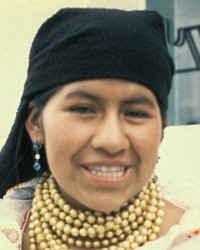

The Calderon Highland Quichua are an indigenous Andean people inhabiting the mountainous regions of the highlands near Quito, Ecuador. They are part of the broader Quichuan language family whose roots trace to the Inca Empire, which introduced this language to the region in the fifteenth century. When Spanish colonizers arrived in the sixteenth century, they adopted Quichua as the lingua franca for colonial administration, making it the dominant language of interaction between conquistadors and indigenous peoples. Over five centuries, Quichua evolved into distinct regional dialects across Ecuador's highlands, with the Calderon Highland variety developing unique linguistic features influenced by pre-Incan languages.
The Calderon Quichua communities flourish on the Guanguiltagua plateau north of Quito, a region chosen for its temperate climate. For centuries, they have maintained agricultural traditions rooted in mountain ecology and the sacred relationship between earth and people. Spanish colonization profoundly transformed their worldview, displacing indigenous deities with Catholic saints and imposing feudal labor systems. Despite centuries of subjugation and cultural pressure, the Calderon Quichua preserved their language, distinctive traditional dress, and community identity. In recent decades, they have actively organized politically to defend indigenous rights and land claims. The Calderon communities maintain distinctive cultural practices including the celebration of Day of the Dead, the crafting of handmade marzipan and carved wooden furniture—traditions that have transcended generations and maintained cultural significance despite urbanization pressures.
The Calderon Highland Quichua are primarily subsistence and commercial farmers cultivating crops suited to mountain agriculture. Potatoes, maize, beans, and root crops form the foundation of their diet and economic survival. Many families also raise livestock including cattle, pigs, and chickens, with animals serving dual purposes as both sustenance and investment. Contemporary Calderon Quichua engage in traditional crafts including woodcarving and the production of elaborate marzipan figures for celebration, generating income through local markets and tourist commerce near Quito.
Family life centers on extended kinship networks and collective decision-making rooted in Andean traditions. Households typically include multiple generations working together in agricultural tasks. Women hold significant roles in household economy and cultural transmission, maintaining traditional weaving practices and food preparation knowledge. Men contribute to agricultural labor and animal husbandry while often engaging in woodcarving and craft production. Children participate in age-appropriate agricultural work and cultural learning from an early age.
Food reflects mountain agriculture and seasonal availability. Meals emphasize potatoes prepared in diverse ways, supplemented with beans, maize-based dishes, fresh vegetables from mountain gardens, and occasional meat from domestic animals. Traditional celebrations center on the Day of the Dead on November 2nd, when families prepare special foods, honor deceased ancestors, and gather for multi-day festivities. Agricultural festivals mark planting and harvest seasons, with community gatherings and shared meals reinforcing social bonds. Carnival celebrations and religious feast days provide occasions for music, dancing, and community-wide festivities.
Traditional dress remains important to Calderon Quichua identity, particularly for women who wear distinctive ponchos, embroidered blouses, and colorful shawls that visually identify them to their community. Men maintain traditional styles including ponchos and felt hats. The Calderon Quichua speak their native Highland Quichua dialect while increasingly adopting Spanish for communication beyond their communities, particularly among younger generations exposed to formal education and urban employment.
Traditional Calderon Quichua spirituality centered on reverence for the earth (Pacha Mama) and a hierarchical cosmos inhabited by various spiritual forces. The Inca concept of Inti Raymi, the festival of the sun, remains significant to Andean identity and continues to influence seasonal celebrations. Indigenous cosmology emphasized reciprocal relationships with nature and the spiritual realm, with ritual specialists conducting ceremonies to maintain cosmic balance and agricultural productivity.
Spanish colonization introduced Roman Catholicism, which the Calderon Quichua adopted while maintaining underlying indigenous beliefs and practices. This resulted in folk Catholicism—a syncretistic blend of Catholic rites and indigenous Andean spirituality. Religious festivals incorporate both Catholic and indigenous elements, with celebrations often featuring traditional music, community gatherings, and rituals honoring both saints and earth spirits.
In recent decades, evangelical Protestant churches have gained significant presence throughout Ecuador's indigenous communities, including among the Calderon Quichua. Missionaries from various evangelical denominations have established churches and conducted outreach, particularly since the 1960s. This has created a diverse religious landscape where evangelical Protestant communities coexist with Catholic parishes and folk religious practitioners. Some Calderon Quichua have embraced evangelical Christianity with genuine commitment, while others maintain syncretistic practices combining Catholic saint veneration with indigenous beliefs.
Language preservation represents an urgent concern as Spanish increasingly displaces Quichua among younger generations, particularly in urban areas where indigenous youth pursue formal education and modern employment. Educational infrastructure requires strengthening with culturally-appropriate curriculum honoring indigenous knowledge alongside academic learning. Economic pressures drive migration to lowland cities and migration abroad for employment, separating families and weakening community continuity and cultural transmission.
Land rights remain contested, with Calderon communities seeking legal recognition of ancestral domains while facing encroachment from urban expansion, agricultural corporations, and development projects. Access to quality healthcare remains limited in remote mountain areas, with indigenous peoples experiencing health disparities. Discrimination from mestizo society persists, affecting economic opportunities and social dignity.
Pray that the Holy Spirit awakens genuine, saving faith among the Calderon Highland Quichua, calling them to abandon syncretistic practices and commit fully to following Jesus Christ as Lord and Savior.
Ask God to raise up from within the Calderon Quichua community Spirit-gifted pastors, evangelists, and teachers equipped with theological training and cultural wisdom to establish indigenous reproducing churches.
Pray that Calderon Highland Quichua believers become catalysts for spiritual awakening throughout Ecuador's Andean communities.
Pray for the Holy Spirit to move powerfully in their churches and families, blessing them in every way.
Scripture Prayers for the Quichua, Calderon Highland in Ecuador.
Ecuador.com. "Ecuador Languages." https://www.ecuador.com/culture/language/
Ethnologue. "Quichua, Calderón Highland Language (QUD)." https://www.ethnologue.com/language/qud/
International Journal of American Linguistics. "Ecuadorian Highland Quichua and the Lost Languages of the Northern Andes." https://www.journals.uchicago.edu/doi/10.1086/717056
ELDP Endangered Languages Documentation Programme. "Urgent video documentation of Ecuadorian Highland Quichua." https://eldp.access.preservica.com/dk0485/
Embassy of Ecuador. "Destinations of Interest." http://www.embassyecuador.eu/site/index.php/en/turismo-inf-general/turismo-destinos-interes
PeoplesOfTheWorld.org. "Indigenous peoples of the world — the Quichua." https://www.peoplesoftheworld.org/text-people=Quichua
The World from PRX. "Evangelical churches flourish among Indigenous communities in Ecuador." https://theworld.org/stories/2025/07/28/evangelical-churches-flourish-among-indigenous-communities-in-ecuador
UKEssays. "The Kichwa Or Quichua In Ecuador History Essay." https://www.ukessays.com/essays/history/the-kichwa-or-quichua-in-ecuador-history-essay.php
Wikipedia. "Religion in Ecuador." https://en.wikipedia.org/wiki/Religion_in_Ecuador
| Profile Source: Joshua Project |



