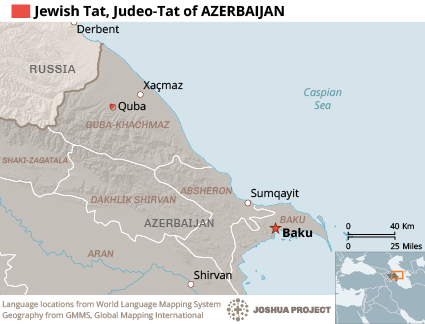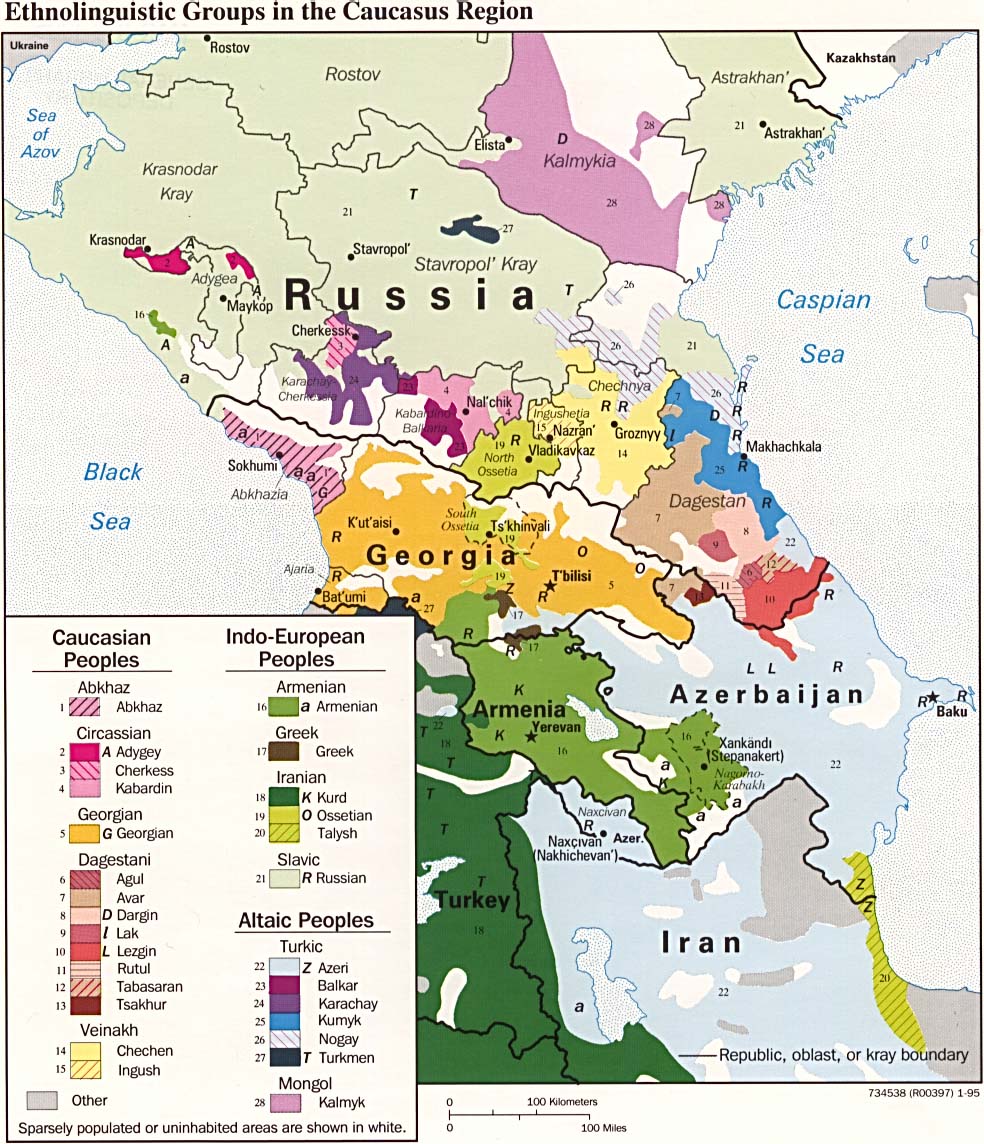

The Mountain Jews are also known as Caucasus Jews or Persian Jews. They originally were taken to Persia from Israel following the destruction of Solomon's Temple, in 587 BC when they were conquered by the Assyrians. Over 2,000 years ago they faced ongoing persecution in Persia. This forced them to migrate to Azerbaijan where they adopted the Muslim Tat language. Using the Tat language, they developed what became a distinct Jewish dialect called Judeo-Tat or Judeo-Persian. Many of them became farmers and peacefully lived in the small, isolated villages located close to the Black and Caspian Seas. Living in their remote villages allowed them to maintain their Jewish culture and religious beliefs according to the teaching found in the Jewish scriptures of the Old Testament.
Work life among the Mountain Jews has historically centered on trade and skilled crafts. Many were known as merchants, as well as artisans such as tanners and furriers, and these occupations played an important role in sustaining local economies. In more recent times, many have entered a variety of occupations, including small business ownership, transportation services, and professional work, particularly in urban centers such as Baku. At the same time, some community members travel or work abroad while maintaining close ties to their home communities in Azerbaijan.
Family life among the Mountain Jews is close-knit and strongly rooted in tradition. The family serves as the primary center of social and cultural life, and there is a strong emphasis on preserving ethnic identity through marriage and community relationships. In many cases, families prefer marriages within the Mountain Jewish community to maintain their distinct heritage. Extended families often remain closely connected, even when members live in different countries, and it is common for relatives to return to their home communities for major life events such as weddings and celebrations.
Community life is closely tied to shared traditions and communal institutions such as synagogues and neighborhood networks. The Mountain Jews are known for maintaining vibrant communal structures, particularly in places like the Red Village, which functions as a cultural and social center for the group. Their distinct language, Judeo-Tat, and their shared history further strengthen family and community cohesion.
Recreation among the Mountain Jewish people is often centered on community interaction and cultural expression. Social life frequently involves gathering with friends and relatives in public and private settings, where people spend time talking, sharing meals, and enjoying one another's company. In village settings, it is common for individuals to meet outdoors in the evenings, reflecting a relaxed and communal pace of life.
Cultural activities also play an important part in recreation. Music, traditional celebrations, and religious festivals provide opportunities for enjoyment and reinforce community bonds. These events often include singing, dancing, and shared meals that reflect both Jewish and regional Caucasian influences.
In addition, recreation may include informal activities such as games, conversation, and participation in community events, which serve to strengthen relationships and preserve cultural identity. Even as many Mountain Jews engage with modern forms of entertainment, traditional forms of social recreation remain central to their way of life.
Historically, Mountain Jews have always had a rabbi and a Dayan to carry out the spiritual duties in their synagogues. The rabbi performed the duties in the synagogues and the teaching of the Jewish text as given in the Old Testament. A Dayan was the chief rabbi of a town who presided over the Beit din (house of judgement) or court. In ancient times, it was the building block of the legal system in the Biblical Land of Israel. Today, it is invested with legal powers in several religious matters specifically related to Jewish religious life.
The effect of 70 years of communist rule deeply effective the traditional Jewish life of the Mountain Jews in Azerbaijan. They no longer followed their religion regarding the reading Jewish literature, attending the synagogue or celebrating Jewish Holidays.
Resistance to outreach has closed the Mountain Jews off from being willing to listen to the gospel. They need caring and patient Christ followers to befriend them so they will be open to hearing how Jesus the Messiah will bless their lives and families.
Pray that Mountain Jewish people in Azerbaijan will be willing to view the JESUS Film and listen to Bible Broadcasts with open hearts and minds.
Pray that God will work on the hearts of Christians believers to establish friendships with these Mountain Jewish people.
Pray for these Jewish people to have the spiritual hunger it takes to put Jesus first in their lives no matter what the social cost.
Scripture Prayers for the Jewish, Gorsky-Kavkazi (Mountain Jewish) in Azerbaijan.
ChatGPT
toursbaku.com
aze.media
en.wikipedia.org
chabad.org
| Profile Source: Joshua Project |