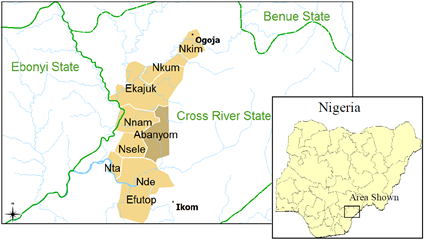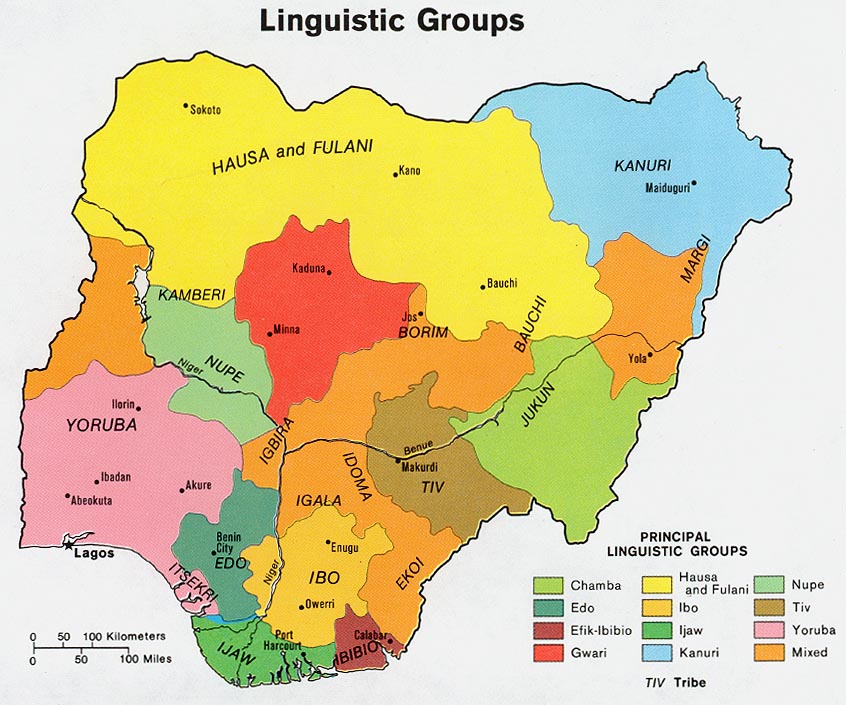

The Abanyom people along with the Ekajuk, Nnam, Nkim, Nkum, Nselle, Nta, Nde, and Efutop are all part of the Bakor cluster. Originally from Emeatal and Etikpe, the people have now settled in the western-most part of Cross River State, Nigeria.
They are very proud of their own language and say that they would like their children to learn to read and write in Abanyom. Currently most schooling is conducted in English. A few people are attending an adult education program that is being held in some areas. The teaching is done in English, but Abanyom is used for discussion amongst themselves.
Most people, especially the youth, understand and speak some English. English is spoken with outsiders and those who don't understand Abanyom. However, the people say that the most useful language in their own villages is Abanyom. When asked which language God likes, the elders responded, "All the languages! He created every language!"
In agricultural communities like the Abanyom, recreation is often woven into daily life rather than separated from it. Periods following communal labor, such as harvest time, are especially marked by increased social activity, feasting, and celebration.
Traditional music and dance form a central part of leisure activity. The Abanyom often participate in group dances accompanied by drums, clapping, and singing. These performances are not only artistic expressions but also serve as important occasions for relaxation, celebration, and the preservation of cultural identity. Festivals and ceremonies provide opportunities for extended communal entertainment, where storytelling, song, and dance are enjoyed by all age groups.
Informal games and physical activities are common, especially among children and young people. These may include locally organized sports, running games, and contests of strength or agility. Such activities are typically played in open village areas and contribute to both physical development and social bonding.
Storytelling is another valued recreational practice. Elders often share oral histories, proverbs, and folktales during the evenings. These gatherings provide entertainment while also transmitting moral lessons, cultural values, and the collective memory of the people.
There are many churches in the Abanyom villages. Every village has at least one Roman Catholic Church. Other denominations in the area include Deeper Life, Assemblies of God, Methodist, Presbyterian, Christ For the World, and Apostolic. Most churches use English translations of the Bible, even though the children and grandparents don't understand it well.
The Abanyom do not officially have a written language. The elders report that the only thing they have ever seen written in their language is a political speech. There is no standard written form of the language.
Pray for the Abanyom children and grandparents to hear the gospel in a new way.
Thank God for all the churches among the Abanyom.
Pray that the Holy Spirit will move powerfully among the Abanyom Christians, thrusting them out as Christ's ambassadors to a dying world.
Pray for Abanyom disciples to make more disciples
Scripture Prayers for the Abanyom in Nigeria.
Anonymous
| Profile Source: Joshua Project |