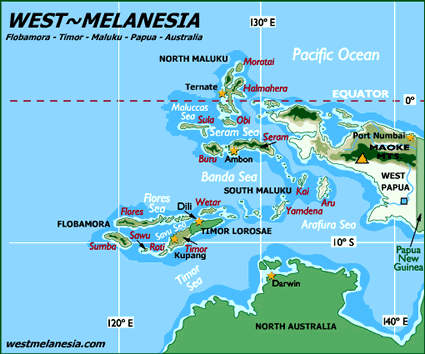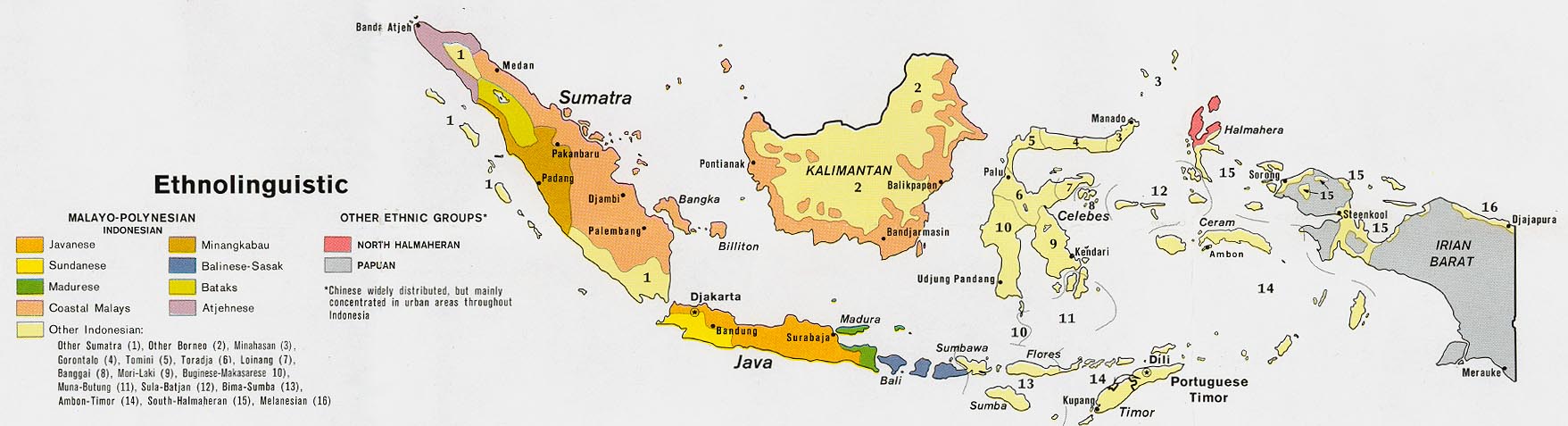
The Wahai Manusela, more commonly known simply as the Manusela people (also called Wahai), are an indigenous ethnic group living in the central highlands and coastal zones of Seram Island in the Maluku Province of Indonesia. Their native tongue is the Manusela language, also known as Sou?Upaa or Wahinama, which belongs to the Austronesian language family.
Historically, the Manusela have occupied remote villages in the forested interior of Seram, particularly in mountainous terrain, as well as settlements along Teluti Bay. Their cultural heritage has been shaped by a deep connection to the forested landscape, and they co?exist with the Manusela National Park, whose terrain includes rivers, hills, and rich biodiversity.
The daily life of the Wahai Manusela is intimately tied to their rugged forested environment and the rhythms of the island. Many Manusela families engage in subsistence agriculture, hunting, and gathering forest products. Sago palms, root crops, bananas, and other forest foods are staples, while fertile patches of land are used to grow garden crops. Their mountain setting also offers streams and rivers where small-scale fishing may contribute to their food supply.
Family relationships in Manusela society are traditionally communal: extended families often live in the same settlement or in nearby hamlets, helping one another with farming, gathering, and caring for children or elders. Elders carry respect and informal authority, and traditional customs are passed down through generations by story, ritual, and shared labor.
Celebrations among the Manusela people reflect both their traditional culture and more recent influences. Important communal events occur around life?cycle milestones such as births, marriages, or deaths, and these are frequently tied to ritual acts that honor ancestors and the forest world. Their connection to the land is also expressed in seasonal or subsistence cycles when harvests or forest yields prompt gatherings. Because Christianity has reached some Manusela communities, church-based celebrations and worship gatherings increasingly shape their communal life.
Their diet is deeply shaped by what the forest and land yield. Sago remains a central food item, supplemented by root tubers, wild yams, forest greens, and hunted or fished protein. In coastal or riverside settlements, fish may be more prominent in their meals, and foods are often prepared in simple, traditional ways.
The Wahai Manusela have historically practiced a syncretic faith known locally as Naurus, which blends animistic beliefs with influences of Hinduism, especially in ritual and ancestral veneration. Their spiritual worldview holds that nature and ancestors are alive with power, and traditional ceremonies often invoke ancestral spirits or guardian forces connected to the forest, rivers, or mountain places.
Over time, some Manusela have embraced Protestant Christianity, and Christian teaching has begun to influence their spiritual identity. Even among those who identify as Christian, many still hold on to old customs. Traditional rituals may continue alongside church worship, and older beliefs are woven into how they understand life, death, and the supernatural.
The Wahai Manusela people face significant physical and spiritual needs. Their remote and often rugged homeland restricts access to consistent healthcare, and many villages may struggle with limited medical facilities, especially for mothers, children, and the elderly. Education is also challenging. Children in mountain or forest villages are often far from schools, and educational resources may be scarce. Economically, the Manusela depend heavily on subsistence farming, forest gathering, and other low?income activities, leaving families vulnerable to environmental changes or resource pressures.
On the spiritual side, many Manusela have only a very mixed understanding of Christian faith, so there is a profound need for the gospel to be communicated in a way that respects their culture and history. Local believers or emerging Christian leaders would benefit greatly from discipleship training, Bible translation, and culturally relevant teaching so that the church among the Manusela can grow and mature.
Pray that the Lord would give the Wahai Manusela people spiritual hunger, so that those who have never heard the gospel might come to understand the hope and love of Jesus Christ in a way that resonates deeply with their world.
Pray for their physical well?being, asking God to provide access to health care, clean water, and educational opportunities in their remote mountain and forest communities.
Pray that God would raise up disciple?making believers from among the Manusela who can serve as indigenous witnesses, bridging Christian faith and their traditional culture in their own language.
Pray for resources for Bible translation, Christian training, and church planting, so a thriving and multiplying discipleship movement can take root among the Manusela and reach future generations.
Scripture Prayers for the Manusela, Wahai in Indonesia.
Wikipedia, Manusela people.
Wikipedia, Manusela language.
LingWeb – data on Sou Upaa / Manusela numerals.
Telusur Indonesia / Telusurindonesia blog – Manusela National Park geography.
telusurindonesia.wordpress.com
Kent Academic R
| Profile Source: Joshua Project |