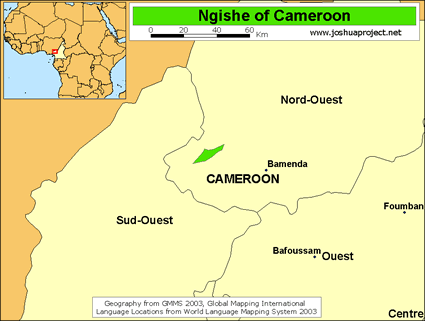
The Ngishe, also known by the language name Ngoshie and closely associated historically with the village of Oshie in the Njikwa Sub-division of the Northwest Region of Cameroon, are a small Bantu-speaking people of the Grassfields cultural area. Their language, Ngoshie, is a southern Bantoid Grassfields tongue closely related to the Ngie language.
Locals often refer to themselves as Oshie rather than "Ngishe," and their homeland lies in the hilly terrain of the Bamboutos Highlands where settlement patterns reflect long-standing Grassfields village traditions. Historically, the Oshie/Ngishe moved into their present upland territory from areas to the west and north, driven by regional migrations tied to broader Bantu movements in the Grassfields and pressures such as the spread of Islam in earlier centuries. The village of Oshie itself was established by migrant communities who displaced earlier Konda and Beba inhabitants, choosing elevated sites for defensive advantage.
In daily life, Ngishe families are rooted in village-centered agrarian rhythms typical of the Grassfields of inland Cameroon. Most adults engage in subsistence farming and small-scale cultivation, tending crops such as cassava, plantains, maize, beans, and other staples that thrive in the highland soils. Farming is both a means of livelihood and a communal activity, with relatives cooperating across extended family lines. Activities such as preparing garri (tapioca), tending livestock, and participating in seasonal agricultural cycles occupy much of their time. Community structures are often organized by familial quarters and traditional leadership roles, with elders and family heads playing important roles in decision-making.
Family bonds are strong, and extended households may include grandparents, aunts, uncles, and cousins under one compound or in closely knit quarters. Respect for elders and communal cooperation reflect wider Grassfields cultural values emphasizing social solidarity and mutual support. Children contribute to household tasks from an early age, helping in gardens, fetching water, and caring for younger siblings, while older youth often migrate seasonally or permanently to nearby towns seeking education or employment opportunities.
Celebrations among the Ngishe blend local customs with broader Cameroonian traditions. Weddings, funerals, harvest festivals, and Christian holy days are occasions for communal feasting, dancing, and music. Traditional foods may include fufu or garri served with rich stews and stewed greens, often accompanied by goat, chicken, or other protein sources when available, and these are shared in communal settings that reinforce bonds of kinship and hospitality.
The religious landscape among the Ngishe reflects a blend of Christian adherence and traditional beliefs. The majority of Ngishe identify with Christian traditions, with many influenced by both Roman Catholic and various Protestant expressions of faith. Church services and Christian celebrations such as Christmas and Easter are important markers in the community calendar, and attendance at worship gatherings provides a regular rhythm of spiritual life and fellowship.
However, only a small percentage of the population is counted as evangelical, meaning that while many identify as Christian, deep gospel transformation and biblical discipleship are still limited in scope. Scripture translation efforts for Ngoshie are only in early stages, and ministry resources such as the Jesus Film and local language audio Scriptures are not yet widely available, which affects deep engagement with the message of Jesus in the heart language.
At the same time, traditional spiritual concepts persist in cultural memory and practice. Many Grassfields peoples uphold beliefs about ancestral spirits, blessings, and misfortune being connected to the spiritual realm. Even among nominal Christians, ancestral respect and local customs continue to shape how people understand health, fortune, and community unity. While not all Ngishe practice indigenous religion formally, the influence of pre-Christian worldviews remains present in family rites, local celebrations, and community rituals that have not been fully displaced by outside religions.
The Ngishe community faces both spiritual and practical challenges that shape their daily reality. Access to gospel resources in their heart language remains limited, which constrains deep spiritual growth and local Church development. Without a complete Bible or widely available audio/visual Scripture materials in Ngoshie, believers often rely on secondary languages during worship and teaching, which can hinder comprehension and discipleship. Local believers have a strong desire for teaching that connects the truths of Scripture with their cultural context, enabling them to become effective witnesses among their own people.
Economically, like many highland agrarian communities, the Ngishe contend with limited access to infrastructure, reliable markets, and educational opportunities beyond primary levels. Youth often leave their villages in search of schooling or employment in nearby towns, which can strain family structures and reduce the number of workers available for communal labor. As they engage traditional farming systems, challenges such as soil depletion, unpredictable weather patterns, and limited access to agricultural support services affect food security and income generation.
In the realm of health and wellness, access to quality medical care is less robust in rural highland areas, and families often depend on traditional remedies and periodic visits to distant clinics. Strengthening community health knowledge and access to services would support overall wellbeing alongside spiritual flourishing.
Culturally, the Ngishe desire greater preservation and appreciation of their language and heritage. Documentation efforts, literacy development in Ngoshie, and community leadership training are all essential for ensuring that their cultural identity thrives alongside meaningful engagement with the gospel.
Pray for a deep Christ-centered spiritual awakening among Ngishe believers, that they would seek Jesus with hearts fully surrendered and become bold witnesses in their families and villages.
Pray for the Lord to raise up local teachers and pastors who can communicate biblical truth clearly in Ngoshie and disciple others in Scripture.
Pray that translation work and Scripture engagement tools in the Ngoshie language would accelerate, enabling people of all ages to hear and understand God's word in their heart language.
Pray that soon Ngishe disciples will make disciples among their own people and others.
Scripture Prayers for the Ngishe in Cameroon.
Ngoshie (langue) — French Wikipedia on the language and ethnolinguistic notes relevant to cultural identity.
Culture of Cameroon — Wikipedia / EveryCulture / AFS International sources for broader societal norms, family life, food, and traditions in r
| Profile Source: Joshua Project |