


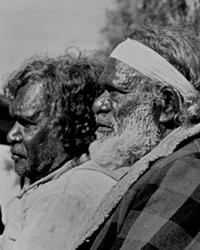

The Pintupi-Luritja people are an Aboriginal group from the central desert regions of Australia, particularly spanning parts of the Northern Territory and Western Australia. They are closely related to neighboring Western Desert groups, and their identity reflects a blending of Pintupi and Luritja heritage, including shared language features and cultural traditions.
Traditionally, the Pintupi-Luritja lived as nomadic desert dwellers, moving across vast stretches of arid land in small family groups. Their movements were guided by deep environmental knowledge, especially concerning water sources, seasonal changes, and the behavior of animals. Among the last Indigenous groups in Australia to have sustained contact with outsiders, some Pintupi people lived in relative isolation well into the modern era before relocating to settlements.
Despite the pressures of settlement life and outside influence, the Pintupi-Luritja have retained a strong attachment to their ancestral lands. Their history is marked by resilience, as they have navigated dramatic changes while seeking to preserve their cultural identity.
Today, many Pintupi-Luritja people reside in remote communities such as Kintore and Papunya, while others live in regional towns. Community life often revolves around extended family networks, where kinship ties shape daily responsibilities, social structure, and decision-making.
Although modern housing and services are present, traditional practices remain important. Hunting and gathering still play a meaningful role, especially for kangaroo, small game, and bush foods like seeds and roots. These activities are not only practical but also reinforce cultural knowledge and identity.
Art is a prominent feature of Pintupi-Luritja life. Many are involved in the Western Desert art movement, producing paintings that convey stories of the land and ancestral journeys. These works have gained recognition far beyond their communities, offering both income and a means of cultural expression.
Language is a vital part of daily life. Pintupi-Luritja dialects are spoken widely within communities, often alongside English. Maintaining language use helps preserve cultural continuity, even as younger generations interact with broader Australian society.
The Pintupi-Luritja people traditionally hold beliefs centered on spiritual forces and ancestral beings connected to the land. These beliefs are expressed through stories, ceremonies, and a strong sense of place, where specific locations carry deep spiritual meaning.
According to available information, over half of the Pintupi-Luritja people identify as Christian due to past missionary influence. However, traditional spiritual perspectives often remain influential and may exist alongside Christian identity. In many cases, understanding of biblical teaching may be limited or blended with older beliefs.
Scripture portions are available in languages accessible to this group, creating opportunities for clearer communication of the gospel. Even so, consistent engagement with the Bible is not yet widespread.
The Pintupi-Luritja people face practical challenges common to remote desert communities, including limited access to healthcare, education, and stable employment. Geographic isolation can make it difficult to maintain consistent services and opportunities for growth.
Spiritually, there is a need for the message of Jesus Christ to be clearly understood and personally embraced. Where Christianity is known, it may not always be rooted in a strong biblical foundation. Clear teaching that connects Scripture to their cultural worldview is essential.
There is also a pressing need for local believers to be equipped as leaders. When individuals from within the community are grounded in God's Word and empowered to disciple others, the church can grow in strength and maturity.
Pray that the Pintupi-Luritja people would encounter the truth of the gospel in a way that speaks clearly within their cultural setting.
Pray for revival in their churches, leading them to become workers among unreached immigrant groups.
Ask God to raise up faithful leaders from among them who will teach Scripture and guide others in following Christ.
Pray for families to be strengthened, with a growing desire to know and live by God's Word.
Ask that Scripture resources in their language would be widely used and deeply understood.
Pray for those in remote communities to receive both practical support and spiritual encouragement.
Scripture Prayers for the Pintupi-Luritja in Australia.
| Profile Source: Joshua Project |



