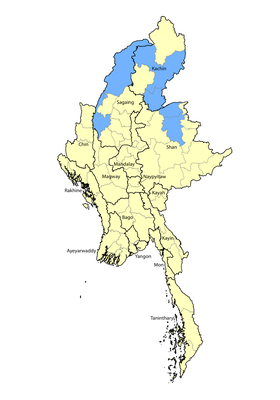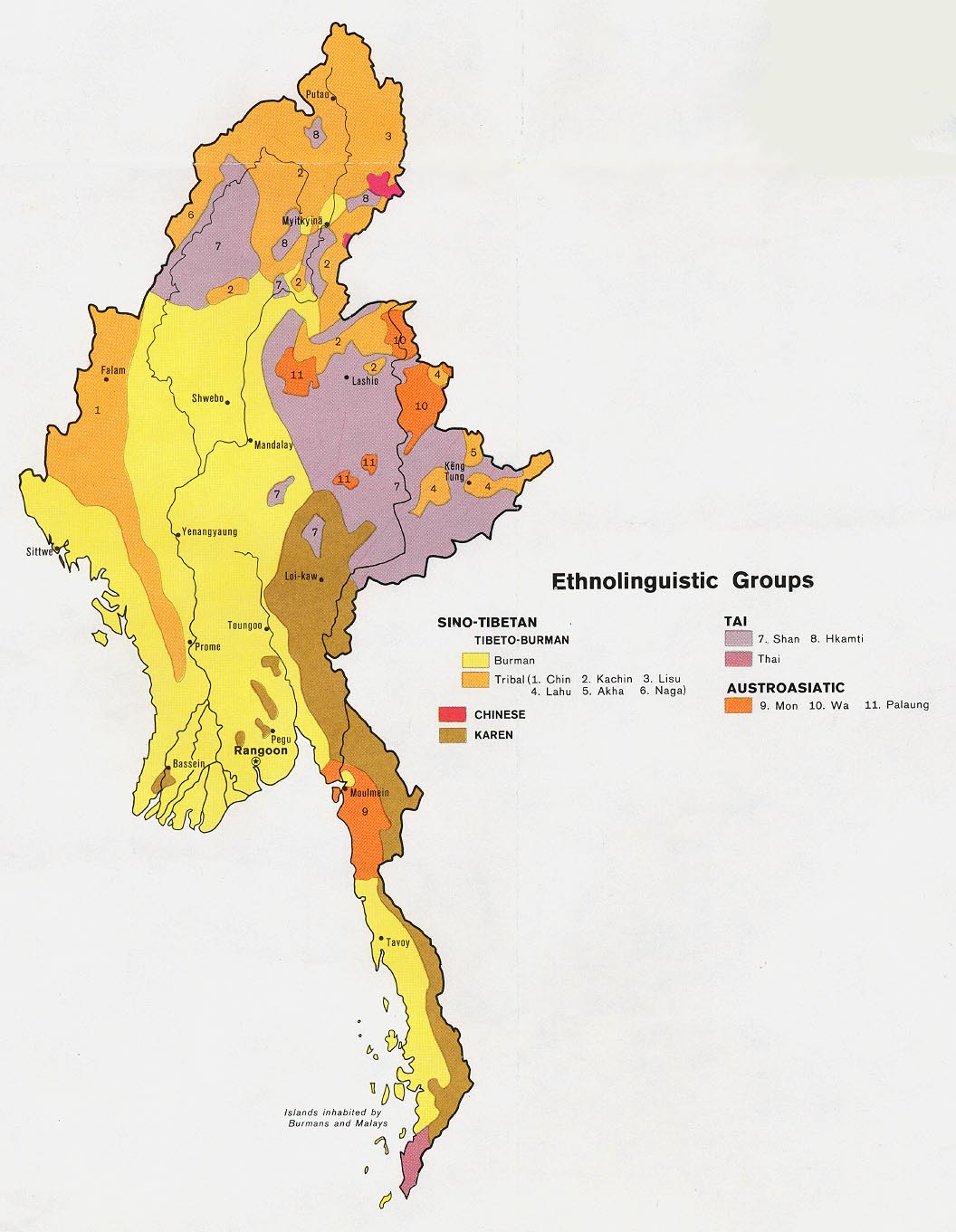

More than one million Kachin Jingpo people inhabit a wide area of northern Myanmar, with hundreds of villages spread across Kachin and Shan states. Others dwell in Yangon, Mandalay, and other urban centers. An estimated 34,000 Jingpo people live across the border in China's Yunnan Province, while 9,500 live in the northeast Indian state of Arunachal Pradesh, where they are known as the Singpho. The Singpho migrated from northern Myanmar in 1793 "after a reign of terror was let loose by the Ahom king."1
The term "Kachin" refers to a collection of cultural groups rather than an ethno-linguistic classification, and most of the Kachin in Myanmar are part of the Jingpo group. When the American missionary Eugenio Kincaid passed through their area in the 1830s, he asked a group of people who they were. They replied that they were villagers from Gahkyeng. He wrote "Kakhyen" in his notes, and Western writers used that name to describe the group until 1899, before the spelling subsequently morphed into Kachin.
A scholar noted in the 1970s that "it is inaccurate to speak of the 'Kachin language.' Many people either know nothing of Jingpo or are quite ill at ease when endeavoring to communicate in it."2 The Jingpo vernacular is used in local newspapers and on radio and television, and the publication of the Jingpo Bible in 1927 established it as the premier Kachin dialect. For centuries, the Jingpo believed that God once gave all races of men a copy of His Word, but the Jingpo lost it on the journey home.3 In India, the Singpho language has changed markedly from its original Tibeto-Burman form due to their close interaction with the Tai-speaking Khamti people.4 It now shares only a 50% lexical similarity with the Jingpo spoken in Myanmar.5
The Jingpo are known to have been living along the Yunnan-Myanmar border at the start of the 16th century.6 For countless generations, they handed down an account of a global flood in which two orphans survived by floating in a large, oval-shaped drum.7 The Kachin Independence Army was formed in the early 1960s, and has grown to become probably the country's most powerful military force in the protracted civil war against the Burmese junta. Many Kachin soldiers are committed Christians.
Before their mass conversion to Christianity, Kachin Jingpo society was bound by darkness, with a visitor in the 1890s writing: "Robbery and murder would seem to be among their principal occupations. They are an independent, lawless, and wicked people, who practise rudely some of the arts of civilization."8 The Kachin Jingpo's openness to the claims of Christ was helped by their ancient belief in a supreme being who is both the creator and judge of all mankind.
Their way of life is closely tied to agriculture, which remains the primary source of livelihood for most families. They commonly cultivate crops such as rice, maize, and vegetables, and in some areas they also engage in livestock raising. Farming is often labor-intensive and requires cooperation among family members and neighbors, reinforcing strong community bonds.
In addition to agriculture, some Kachin Jingpo participate in trade or work connected to the region's natural resources. Kachin State is rich in minerals such as jade, gold, and timber, and some individuals are involved in mining or related economic activities, either directly or indirectly.
Village leadership and social structure are important aspects of their work life. Traditionally, authority has been vested in local leaders—referred to as "masters of the mountains"—who oversee community affairs and help maintain order. Even in modern times, respect for leadership and communal cooperation continues to shape how work is organized and carried out.
Recreation among the Kachin Jingpo is strongly communal and deeply connected to their cultural traditions. Rather than focusing on individual leisure activities, they emphasize festivals, music, and dance as primary forms of enjoyment and social expression.
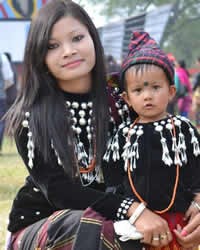
One of the most well-known expressions of Kachin culture is the Manau festival, a large communal celebration that includes traditional dancing, colorful dress, and the gathering of entire communities. These festivals are important occasions for celebration, identity, and unity, often bringing together people from many villages.
Music, storytelling, and oral traditions also play a key role in their recreational life. Songs and dances are often passed down through generations and are used not only for enjoyment but also for preserving history and cultural values. In village settings, social gatherings, shared meals, and conversations provide everyday opportunities for relaxation and relationship-building.
An estimated two-thirds of Kachin Jingpo people in Myanmar today are Christians. The first seven converts were baptized in 1881, and over the ensuing decades, "The inhabitants of these fertile and well-watered hills became Christians in a series of great people movements. Churches of 50,000, 100,000, and a quarter of a million have arisen, and the Bible is honored as God's Word."9 Across the border in India, however, almost all Singpho people remain Buddhists, as they arrived in India about a century before the gospel was first introduced to their cousins in Myanmar.
The headhunting Naga and Tangshang tribes in the Sagaing Region were first penetrated by courageous Jingpo evangelists in 1954, and today those groups are mostly Christian. The Swedish American missionary Ola Hanson spent 36 years translating the Jingpo Bible. It was published in 1927, and the centennial celebrations will soon take place, when hundreds of thousands of believers will give glory to God for how his word transformed this blessed group.
Today the Kachin Jingpo church needs revival. They need to return to their first love, Jesus Christ.
Pray for many Kachin Jingpo Christians to go to the Jingpos in other countries.
Pray for revival fire to consume Kachin Jingpo Christians, leading them to disciple others.
Pray for the Lord to abundantly provide for their needs according to his riches and glory.
Scripture Prayers for the Kachin Jingpo in Myanmar (Burma).
Asia Harvest
1 Sir James George Scott, "Among the Hill Tribes of Burma: An Ethnological Thicket," National Geographic (March 1922), p. 301.
2 Herman G. Tegenfeldt, A Century of Growth: The Kachin Baptist Church of Burma (Pasadena, CA: William Carey Library, 1974), p. 23.
3 Tegenfeldt, A Century of Growth, p. 46.
4 See Kamalesh Das Gupta, A Phrase Book in Singhpo (Shillong: Director of Information and Public Relations of Arunachal Pradesh, 1979).
5 Summer Institute of Linguistics, Ethnologue: Languages of the World (27th edition, 2024), online version.
6 Ma Yin, China's Minority Nationalities (Beijing: Foreign Languages Press, 1989), p. 297.
7 See Ola Hanson, The Kachins: Their Customs and Traditions (Rangoon: American Baptist Mission Press, 1913), pp. 112-13.
8 E. F. Merriam, The Races of Burma (Boston: American Baptist Missionary Union, 1893), p. 11.
9 Tegenfeldt, A Century of Growth, p. 21.
10 Tegenfeldt, A Century of Growth, p. 181.
| Profile Source: Joshua Project |
| Other PDF Profile |