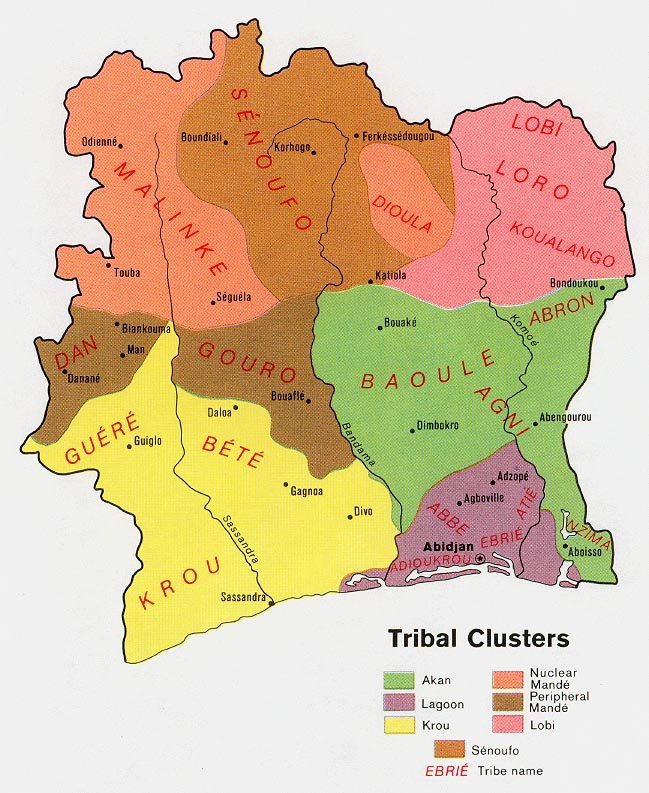

The Attie people, also known as Akye, Atche, Atye, or Akié, live primarily in southeastern Côte d'Ivoire in the Lagunes region and areas north of Abidjan. They speak Attié, a Kwa language belonging to the Niger-Congo family and historically related to the broader Akan linguistic and cultural world, with connections extending to Ghana, Togo, and Benin.
Their history is intertwined with the Akan migrations and the political dynamics of the Ashanti Kingdom. Oral traditions recall that the Attie were once part of Ashanti-related groups who moved westward, eventually settling in the coastal and lagoon regions of present-day Côte d'Ivoire. They are considered among the region's earlier settlers and have maintained a distinct identity shaped by centuries of interaction with neighboring peoples in the Lagoon cultural cluster.
The Attie live in communities shaped by both traditional structures and modern influences. Their territory includes lagoon zones where fishing is a major livelihood, while agriculture—especially cocoa cultivation, along with yams and taro—forms a significant part of daily life. Markets are vibrant and largely managed by women, who hold notable economic influence, while men contribute through fishing, hunting, and land clearing. Both men and women work in farming, making agriculture a shared community responsibility.
Attie society historically organized itself into age-based classes and kinship groups that helped maintain social cohesion and cultural continuity. Artistic expression is meaningful among the Attie, with well?known fertility symbols and sculptural traditions reflecting both lagoon-area aesthetics and influences from neighboring Baule communities. Modern Attie communities continue to balance these traditions with the pressures and opportunities of life near urban centers like Abidjan.
The primary religious affiliation among the Attie is Christianity, particularly Protestant Christianity, which plays a major role in their spiritual identity. Many participate in church life and express their faith through worship, community gatherings, and local fellowship. Although Christianity is well established, spiritual understanding and depth may still vary across communities.
Communities benefit from improved access to stable income sources, educational opportunities, and healthcare, particularly in rural lagoon areas where infrastructure may be limited. Cultural changes and economic pressures create challenges that require wisdom, resilience, and supportive community networks to navigate successfully.
Spiritually, growth in biblical literacy, discipleship, and vibrant Christ-centered fellowship remains important. Continued strengthening of local churches can help believers persevere in faith and extend Christ's mercy to nearby groups with less access to the gospel.
Pray that Attie families will experience stable livelihoods, good harvests, and adequate community resources.
Since the Attie have a strong gospel presence, pray that believers among them will grow in spiritual maturity and join the broader gospel force reaching ethnic groups in Côte d'Ivoire and beyond.
Pray that followers of Jesus will deepen their understanding of Scripture and grow in obedient discipleship.
Pray that churches among the Attie will be strengthened in unity and love, becoming a gospel force to serve other less-reached groups.
Pray that God will raise up faithful workers who demonstrate Christ's compassion and speak His truth clearly among all generations.
Scripture Prayers for the Attie in Côte d'Ivoire.
https://www.101lasttribes.com/tribes/attie.html
https://bing.com/search?q=Attie+people+Cote+d%27Ivoire+ethnic+group
https://www.peoplegroups.org/people_groups/pg013039/
https://joshuaproject.net/people_groups/10483/IV
https://www.frien
| Profile Source: Joshua Project |