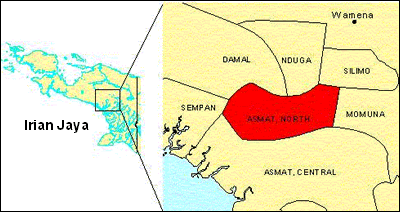
The Northern Asmat live in the northern reaches of the Asmat cultural area in what is now Asmat Regency, South Papua, Indonesia. Historically their villages clustered along rivers, tidal flats, and swampy lowlands where waterways provided the main routes of travel and the forest and mangrove fringes supplied food, building materials, and spiritual meaning. Contact with outsiders increased during the twentieth century, bringing missionary activity, government administration, schooling, and market exposure that altered settlement patterns and created more permanent village centers. Despite these changes, Northern Asmat people retain a distinct cultural identity that is expressed through language, artistry, and kinship ties inherited across generations.
Food and subsistence remain closely tied to the water and forest. Sago is a central staple and is processed from local sago palms; fish, crustaceans, sago grub, and hunted forest game supplement family meals. Dugout canoes are a common mode of travel, and fishing and small-scale hunting continue to be important daily activities. Traditional woodcarving and other forms of artistic expression carry cultural knowledge and serve both ritual and economic roles, with some artisans selling works to visitors or regional markets.
Family life is structured around extended kin networks, and elders play key roles in transmitting customs, stories, and practical skills to younger generations. Ceremonial feasts, communal gatherings, and artistic performances mark important life events and seasonal rhythms, even as Christian worship services and church activities now share time and space in many villages. Limited schooling and occasional wage opportunities draw some young people toward regional towns, while others remain committed to village life and its responsibilities.
Christian faith is the primary religious affiliation among the Northern Asmat, and churches increasingly shape community life and social rhythms. At the same time, elements of ancestral belief persist in many places, and traditional ideas about spirits, ancestors, and the supernatural continue to influence how some families interpret illness, conflict, and misfortune. For many, Christian belief and ancestral practices exist side-by-side as people work through what it means to follow Christ within a cultural worldview formed by river, forest, and clan memory. In communities where the church is well established, believers often seek deeper biblical teaching and discipleship that connects the gospel faithfully to their local language and cultural expressions.
Reliable access to basic healthcare and clean water remains difficult for communities that are reachable only by canoe or by seasonal roads, and this decreases resilience to common illnesses and childbirth complications. Educational opportunities beyond basic village schools are uneven, which limits options for young people who wish to pursue vocational training or leadership roles. Sustainable livelihood options that respect the forest and river environment are needed so that families can support themselves without being forced to choose between cultural preservation and material survival. Skilled Christian leadership that is grounded in Northern Asmat language and culture would strengthen local churches and equip believers for long-term discipleship and evangelistic witness. Efforts to preserve the North Asmat language and to produce Scripture and teaching materials in ways that are culturally relevant would help ensure that faith and cultural identity are passed to the next generation. Responsible development that protects customary lands and resources while improving living conditions would reduce vulnerability to outside exploitation and environmental harm.
Please pray that Northern Asmat believers will grow deeply rooted in Christ and that local churches will become centers of discipleship, healing, and practical compassion.
Pray for pastors and lay leaders to be raised up who can teach Scripture clearly in the languages people understand and who will disciple emerging leaders for service in their own communities.
Pray for provision of clean water and basic healthcare, asking that clinics, mobile health teams, and local training be multiplied so that mothers and children are safer and communities are more resilient.
Pray for educational opportunities that respect Northern Asmat language and culture while equipping the next generation with skills to serve their people.
Pray for creative, culturally sensitive economic initiatives—especially those that build on woodcarving and traditional arts—that provide sustainable income without destroying the environment.
Pray for those wrestling with ancestral fears and spiritual bondage, that the truth and freedom of the gospel will replace fear with peace and hope.
Finally, pray that God will send dedicated workers—both local and long-term partners—who come with humility, cultural respect, and a commitment to help Northern Asmat believers become active participants in the global discipleship movement.
Scripture Prayers for the Asmat, Northern in Indonesia.
https://en.wikipedia.org/wiki/Asmat_people
https://en.wikipedia.org/wiki/North_Asmat_language
https://en.wikipedia.org/wiki/Asmat_Regency
| Profile Source: Joshua Project |