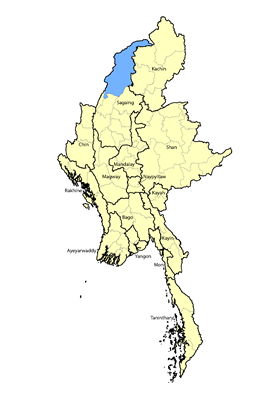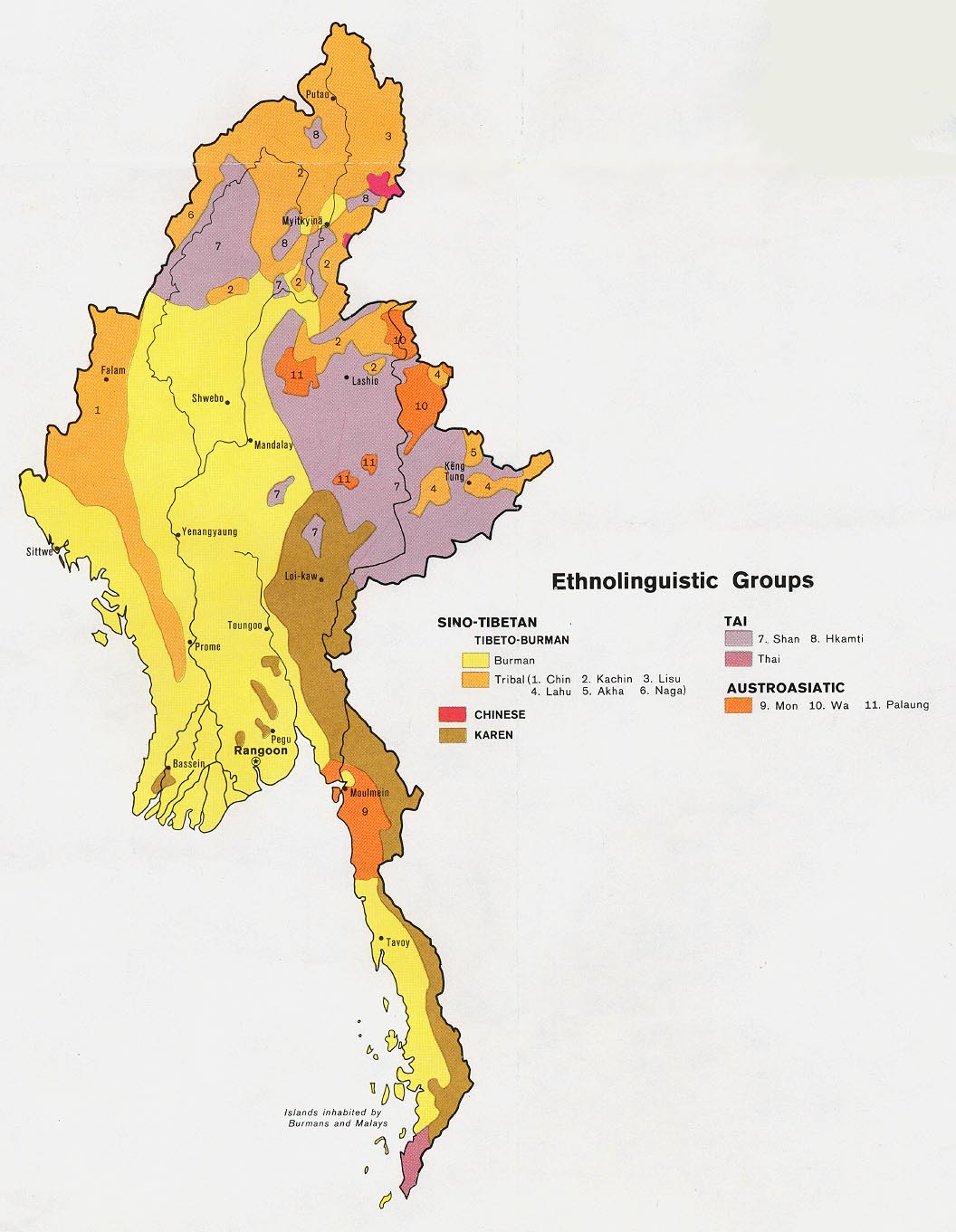

Members of the Maitai tribe live along the border between Myanmar and the juncture of the two northeast Indian states of Nagaland and Arunachal Pradesh. Their community is concentrated in western Myanmar's Sagaing Region throughout Lahe Township in the Naga Self-Administered Zone. The Zone was created in 2010 in an attempt by the Myanmar government to quell insurgencies in the border area by offering nominal autonomy to the many tribes there. The main village of the Maitai people is called Thaho 2, which contained 66 Maitai households in 2013.
The Maitai are a distinct group that has never appeared on any Christian or secular lists of the world's peoples. Although they are broadly related to other Tangshang and Naga tribes, the customs, sense of identity, and speech of the Maitai differs from those of other groups. Many of the tribes in this part of Myanmar are in transition, with 20 out of 32 Maitai people who were interviewed saying they were born elsewhere before their families migrated to Lahe.
After surveying 470 Maitai people in 2012, linguists concluded that their vernacular falls within a cluster of dialects labeled the "Shecyu-Moshang" group, which includes eight other tribes profiled in Operation Myanmar: Cyamcyang, Cyolim, Dunghi, Lochang, Lungri, Moshang, Mungre, and Shecyu.3 Many Maitai people speak Burmese as a second language, which they use when communicating with other ethnicities in the area. Although Maitai reportedly shares an 86 percent lexical similarity with Shecyu,4 the differences are such that the chances of them comprehending the Shecyu Bible are slim.
The strategic area inhabited by the Maitai and other tribes has been a hotbed of ethnic conflict and cross-border insurgencies. One of the Myanmar government's targets has been an armed group called The National Socialist Council of Nagaland-Khaplang, which desires to "establish a sovereign Nagaland spanning Naga ancestral territory on both sides of the India-Myanmar border."
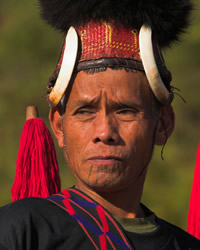
The Maitai share many cultural similarities with Tangshang and Naga tribes in the area, including the common practice of men wearing headdresses adorned with bear fur and huge boar tusks. A lack of educational opportunities holds back many Maitai, with one study finding that of 32 Maitai people interviewed, just one had graduated from high school, ten had only attended primary school (grades 1-4), and six had never received any education at all.6 A local scholar says that many Naga-related tribes in Myanmar, including the Maitai, envy their cousins across the border: "With admiration, they look at their relatives from Nagaland, part of democratic India, comparing their levels of education, healthcare, and road quality. Their experiences reveal the problems faced by all minority groups in repressive Myanmar."
Apart from a small number of families who have embraced Buddhism, most Maitai people attend Baptist churches. The church in Thaho 2 village is led by a Maitai pastor. Cyamcyang and Lochang believers in the village have learned to speak Maitai so they can understand the preaching and participate in the meetings.
Although nearly nine out of ten Maitai people identify as Christians today, their faith is challenged by a lack of Scriptures in a language they can comprehend. In 2013, even the Maitai pastor in Thaho 2 village said that although he owned a Shecyu New Testament, he was unable to understand it.8 Over the years, some Christians in the border area have come under such intense pressure from the Burmese that "they have chosen to abandon their villages, flee into the jungle, and keep Jesus. Others have chosen to become Buddhists to receive benefits from the government, which builds Buddhist monasteries and provides free education for students who board there. The local Christian leadership has very little training or encouragement."
Pray for spiritual renewal among Maitai Christian believers and freedom from syncretism.
Pray for the Lord to bless the work of their hands as they obey biblical principles.
Pray for the Lord to bless them spiritually and physically.
Pray for the believers among them, that they will grow strong in faith and become part of the mission force, carrying the gospel to their own people and beyond.
Scripture Prayers for the Maitai in Myanmar (Burma).
Asia Harvest, Copyrighted 2026 © Used with permission
| Profile Source: Joshua Project |
| Other PDF Profile |