Valmiki (Hindu traditions) in India
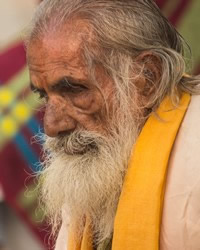
Photo Source:
Copyrighted © 2026
Aathi94 - Shutterstock All rights reserved. Used with permission |
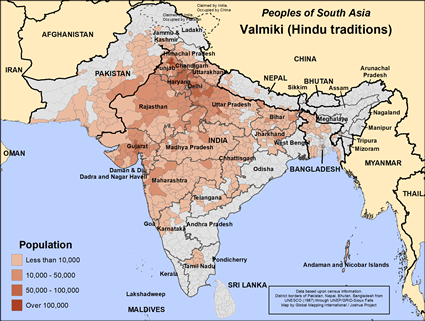
Map Source:
People Group data: Omid. Map geography: UNESCO / GMI. Map Design: Joshua Project
|
| People Name: | Valmiki (Hindu traditions) |
| Country: | India |
| 10/40 Window: | Yes |
| Population: | 5,187,000 |
| World Population: | 5,312,300 |
| Primary Language: | Hindi |
| Primary Religion: | Hinduism |
| Christian Adherents: | 0.00 % |
| Evangelicals: | 0.00 % |
| Scripture: | Complete Bible |
| Ministry Resources: | Yes |
| Jesus Film: | Yes |
| Audio Recordings: | Yes |
| People Cluster: | South Asia Tribal - other |
| Affinity Bloc: | South Asian Peoples |
| Progress Level: |

|
Introduction / History
The Hindu Valmiki are a Dalit community found primarily in northern and central India. They are also known as Balmiki and are traditionally associated with occupations such as sweeping, sanitation work, and waste removal.
The community takes its name from the revered Hindu sage Valmiki, who is traditionally credited with composing the Ramayana, one of the most important epics in Hinduism. Over time, members of this community adopted his name as a way of identifying with a respected spiritual and cultural figure, emphasizing dignity and heritage despite historical marginalization.
Historically, the Valmiki have been classified among India's "Scheduled Castes," often referred to as Dalits, and have faced stigmatization due to their association with occupations considered "polluting" within the traditional caste system. Many were drawn into sanitation work during the colonial period and continued in these roles afterward, shaping both their economic life and social position.
What Are Their Lives Like?
Traditionally, the Hindu Valmiki have worked as sweepers, sanitation laborers, and waste collectors—tasks that society historically considered low-status. Even today, many remain employed in municipal sanitation, though increasing numbers are moving into other forms of labor, government service, and education.
Their daily lives are often shaped by economic challenges and limited opportunities. Many Valmiki families live in urban or semi-urban areas, often in segregated neighborhoods linked to their traditional occupations. Access to clean housing, healthcare, and education can be limited, especially for poorer households.
Socially, the Valmiki have historically faced discrimination within the caste system. From a young age, children may encounter exclusion or prejudice in schools and public settings. Despite legal protections in modern India, social barriers and stigma still affect many aspects of life, including employment and social relationships.
Family life is usually centered around strong kinship ties. Extended families often live close together, providing mutual support in the face of economic hardship. Marriage typically occurs within the community, reinforcing shared identity and traditions.
At the same time, there is evidence of gradual change. Increased access to education, government programs, and social advocacy has enabled some Valmiki families to improve their standard of living and pursue new opportunities beyond traditional roles.
What Are Their Beliefs?
The Hindu Valmiki primarily follow Hinduism and incorporate mainstream Hindu beliefs and practices such as temple worship, festivals, and rituals connected to life events.
Many hold a special reverence for the sage Valmiki, honoring him as a spiritual figure and cultural ancestor. His story—often told as a transformation from a life of wrongdoing to righteousness—serves as a powerful symbol of redemption and moral change.
Their worldview is also shaped by traditional Hindu concepts such as karma (actions and consequences) and reincarnation. These beliefs have historically influenced social attitudes toward caste and life circumstances, sometimes reinforcing acceptance of one's social position.
Because of strong cultural and religious traditions, many Hindu Valmiki have little exposure to or understanding of the gospel. In addition, Hindu identity and community ties can make it difficult for individuals to consider other faiths.
What Are Their Needs?
The Hindu Valmiki face significant spiritual and practical needs. Spiritually, most have not had an opportunity to clearly hear or understand the message of Jesus Christ. Deep cultural ties to Hinduism and longstanding social identity create barriers to gospel access.
Practically, many continue to experience poverty, limited education, and social discrimination. Sanitation work—often hazardous and low-paying—remains common, and workers may lack adequate safety protections or social security.
There is a need for compassionate ministry that both shares the hope of the gospel and addresses real-life challenges. Education, healthcare, job training, and advocacy for dignity and equality can play a vital role in improving quality of life while building trust.
Prayer Points
Pray that the Hindu Valmiki would be adopted through the People Group Adoption program, leading to sustained prayer and gospel engagement.
Pray that believers in India would build genuine relationships with Valmiki families, sharing the love and truth of Jesus Christ with humility and respect.
Pray that a deep spiritual hunger would grow among the Valmiki people, leading many to seek truth and follow Jesus Christ.
Pray for improved access to education, fair employment, and dignified living conditions, bringing hope and transformation to Valmiki communities.