Baloch Palafi in Pakistan

Send Joshua Project a photo
of this people group. |
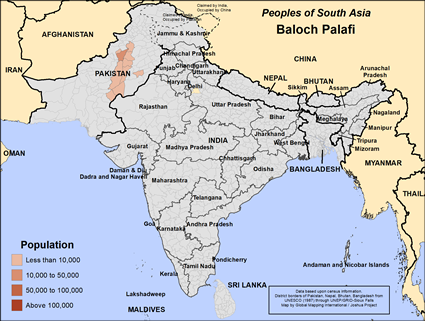
Map Source:
People Group data: Omid. Map geography: UNESCO / GMI. Map Design: Joshua Project
|
| People Name: | Baloch Palafi |
| Country: | Pakistan |
| 10/40 Window: | Yes |
| Population: | 61,000 |
| World Population: | 61,000 |
| Primary Language: | Balochi, Eastern |
| Primary Religion: | Islam |
| Christian Adherents: | 0.00 % |
| Evangelicals: | 0.00 % |
| Scripture: | New Testament |
| Ministry Resources: | Yes |
| Jesus Film: | Yes |
| Audio Recordings: | Yes |
| People Cluster: | Baloch |
| Affinity Bloc: | South Asian Peoples |
| Progress Level: |

|
Introduction / History
The Baloch Palafi are one of the many Baloch tribal communities living primarily in Pakistan, especially in Balochistan and adjoining regions of southern Punjab and Sindh. They are part of the wider Baloch ethnic world that extends across Pakistan, Iran, and Afghanistan. The Palafi speak Balochi along with regional languages such as Saraiki or Sindhi depending on where they live. Their identity is strongly connected to tribal history, clan relationships, and the wider traditions of the Baloch people.
The origins of the Baloch peoples are preserved largely through oral tradition and tribal genealogy. Historical and linguistic evidence suggests that Baloch groups gradually migrated eastward over many centuries into the region now known as Balochistan. During the Mughal period, the territory became widely associated with the Baloch and eventually became known as "Balochistan," meaning "land of the Baloch." The Palafi are one of the tribal branches within this broader ethnic heritage.
Baloch society has historically centered around tribal loyalty, pastoral life, warfare, migration, and strong codes of honor. Tribal chiefs and elders traditionally guided social order and conflict resolution. Despite political change, economic hardship, and modernization, many Baloch tribes, including the Palafi, continue to preserve strong tribal identity and oral traditions. Christian witness among the Baloch Palafi has remained extremely limited, and many have never heard a clear explanation of the gospel.
What Are Their Lives Like?
The Baloch Palafi traditionally depend on a combination of livestock herding and agriculture. Sheep, goats, cattle, and camels remain important in many rural communities. Wheat farming and small-scale agriculture help support families in areas where water and climate conditions permit cultivation. In drier regions, survival often depends on careful management of limited natural resources.
Family and tribal relationships are central within Palafi society. Extended families commonly live close together, and tribal loyalty strongly influences marriage, leadership, and social responsibilities. Elders are respected as keepers of tribal history and customary law. Hospitality is deeply valued, and guests are often welcomed generously with tea, bread, rice, meat, and conversation.
Baloch oral poetry, storytelling, and music continue to play an important role in preserving identity and passing traditions to younger generations. Stories of tribal heroes, migration, and honor remain highly respected within Baloch culture. Traditional dress, especially loose garments and turbans suited to the desert climate, is still common in many rural communities.
Life in many Baloch regions can be difficult because of drought, weak infrastructure, poverty, limited healthcare, and educational challenges. Younger generations increasingly migrate to towns and cities searching for employment and opportunity, creating tension between preserving tribal customs and adapting to modern Pakistani society.
What Are Their Beliefs?
The Baloch Palafi are primarily Sunni Muslims. Islamic practices such as prayer, fasting during Ramadan, mosque attendance, and observance of Islamic festivals shape community life and moral expectations.
Alongside formal Islamic belief, tribal customs and folk religious practices may also influence spiritual life. Some people may seek protection through charms, blessings, shrine visitation, spiritual healers, or beliefs concerning jinn and unseen spiritual forces. In many tribal settings, religion and ethnic identity are closely connected, making conversion to Christianity socially difficult.
Very few known believers exist among the Baloch Palafi. Many have never encountered a follower of Jesus Christ who could explain the gospel clearly in their own language and cultural setting. Access to biblical teaching, discipleship, and Christian fellowship remains extremely limited.
What Are Their Needs?
The Baloch Palafi need greater access to the gospel through culturally understandable evangelism, Scripture resources, and long-term discipleship. Many have little understanding of biblical Christianity or the message of salvation through Jesus Christ alone.
Practical needs are also significant in many Baloch regions. Rural communities often face poverty, drought, water shortages, inadequate healthcare, weak educational systems, and limited economic opportunity. Geographic isolation and tribal structures can make outside engagement difficult in some areas.
The Baloch Palafi would benefit from audio Scripture resources, oral Bible teaching, literacy efforts, vocational assistance, medical outreach, and mature believers willing to learn Balochi language and culture. Relationship-based ministry rooted in humility, patience, and perseverance is greatly needed among them.
Prayer Points
Pray that the Baloch Palafi people would hear the gospel clearly and come to trust in Jesus Christ alone for salvation.
Pray that God would raise up faithful Christian workers who are willing to serve among the Baloch Palafi with wisdom, humility, and perseverance.
Pray that the Baloch Palafi would be adopted through the People Group Adoption program so they receive sustained prayer, ongoing gospel engagement, and future discipleship efforts.
Pray that any believers among the Baloch peoples would grow strong in biblical faith and boldly share the truth of Christ with neighboring tribes throughout Pakistan.