Viswakarma Asari in India

Photo Source:
Jitendra Vishwakarma
|
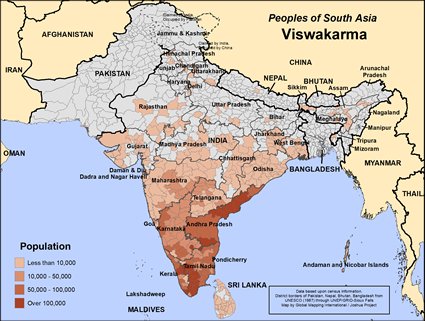
Map Source:
People Group data: Omid. Map geography: UNESCO / GMI. Map Design: Joshua Project.
|
| People Name: | Viswakarma Asari |
| Country: | India |
| 10/40 Window: | Yes |
| Population: | 739,000 |
| World Population: | 739,000 |
| Primary Language: | Malayalam |
| Primary Religion: | Hinduism |
| Christian Adherents: | 0.03 % |
| Evangelicals: | 0.00 % |
| Scripture: | Complete Bible |
| Ministry Resources: | Yes |
| Jesus Film: | Yes |
| Audio Recordings: | Yes |
| People Cluster: | South Asia Hindu - Viswakarma |
| Affinity Bloc: | South Asian Peoples |
| Progress Level: |

|
Introduction / History
According to their traditional belief, the Asari Viswakarmas are descendants of Vishvarkarman, a Hindu deity. The Asari are considered a relatively recent caste formation within the Hindu caste system, which allows for historical flexibility in caste boundaries. Some Asari Viswakarma groups claim higher ritual status, drawing on their association with a divine craftsman lineage, though these claims are not universally accepted by higher-ranking Hindu castes. Community councils and kinship networks continue to regulate marriage, occupations, and social responsibilities.
They live all over India, especially the southern states. Their language is Malayalam, the language of the state of Kerala. The Viswakarma community has several subgroups, one of which is the Asari. Asari Viswakarma community members still work with various practical jobs.
What Are Their Lives Like?
The Asari Viswakarma are traditionally skilled craftsmen and artisans. According to their own traditions, they are descendants of Vishvakarman, the Hindu deity of craftsmen and architects. Their livelihoods have historically included carpentry, stonemasonry, blacksmithing, Jewelry making, metalworking with gold, bronze, and other alloys. These occupations continue to shape their identity, even as many adapt to modern trades or professions. Their work has long been integral to village and temple life, supplying tools, structures, ornaments, and ritual objects.
While artisan labor remains important, many Asari Viswakarma have experienced social and economic mobility. In urban and semi-urban areas, families increasingly pursue formal education, professional employment, and business opportunities. As a result, the community today often spans skilled labor, middle-class trades, and professional occupations, especially in southern India.
What Are Their Beliefs?
Religious life is closely tied to Hindu temples. Asari Viswakarma regularly visit temples for worship
offer prayers, food, flowers, and incense. They participate in household and community rituals intended to gain blessing, protection, and prosperity. Their occupational skills often serve religious ends; items they produce—such as metal objects, ornaments, or architectural elements—are frequently used in temple worship and Hindu ceremonies.
What Are Their Needs?
There are Christians in most areas where the Asari Viswakarma live, so they have the potential to hear and respond to the gospel. However, their hearts are not open to putting all their faith in the only savior.
Prayer Points
Pray for the Holy Spirit to give the Asari Viswakarma people a hunger and thirst for righteousness that will lead them to Jesus.
Pray for Asari Viswakarma family leaders to be blessed by Jesus and recognize that their entire extended families need him as well.
Pray for a church planting movement to spread far and wide among the Asari Viswakarma people.
Pray for vibrant, Holy Spirit led Christians to adopt them and make sure there is a movement to Christ in the coming years.