Balija Bogam in India

Send Joshua Project a photo
of this people group. |
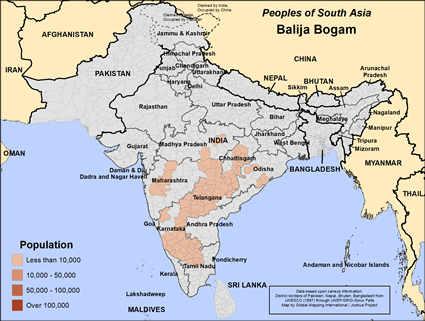
Map Source:
People Group data: Omid. Map geography: UNESCO / GMI. Map Design: Joshua Project
|
| People Name: | Balija Bogam |
| Country: | India |
| 10/40 Window: | Yes |
| Population: | 81,000 |
| World Population: | 81,000 |
| Primary Language: | Telugu |
| Primary Religion: | Hinduism |
| Christian Adherents: | 0.00 % |
| Evangelicals: | 0.00 % |
| Scripture: | Complete Bible |
| Ministry Resources: | Yes |
| Jesus Film: | Yes |
| Audio Recordings: | Yes |
| People Cluster: | South Asia Hindu - other |
| Affinity Bloc: | South Asian Peoples |
| Progress Level: |

|
Introduction / History
The Bogam Balija are a Telugu-speaking community found primarily in the Indian states of Andhra Pradesh and Karnataka. They are also known by the name Natavallolu. The word "Bogam" is associated with pleasure or entertainment because the community was historically connected with dancing and performance traditions. Over time, however, many Bogam Balija moved away from these occupations and entered agriculture, trade, and other forms of labor.
The Bogam Balija are part of the broader Balija social grouping of South India, a large and diverse collection of Telugu-speaking communities with long historical ties to trade, military service, agriculture, and local administration. Many Balija subgroups developed specialized occupations over generations, contributing to the diversity found within the wider Balija identity.
Their history reflects the larger cultural environment of South India, where caste identity, regional language, and Hindu religious tradition strongly shaped social life. Telugu remains central to their identity, and many Bogam Balija are bilingual in Telugu and Kannada depending on where they live. Despite living in regions with a long Christian presence, very few Bogam Balija have had meaningful exposure to biblical Christianity or long-term discipleship.
What Are Their Lives Like?
Most Bogam Balija families today are involved in agriculture, small business, labor, trade, or local service occupations. Rural communities often depend on farming and seasonal labor, while those living in towns may work in commerce or transportation-related jobs. Government assistance programs have also become important for some families facing economic hardship.
Family relationships and kinship ties remain very important within Bogam Balija society. Marriages are commonly arranged by families, and cousin marriage traditions are still practiced in some communities. Social customs surrounding marriage, inheritance, and funerals continue to reflect older South Indian cultural traditions. Sons and daughters may both receive inheritance rights within the family structure.
Food commonly includes rice, lentils, vegetables, chili-based dishes, chutneys, and regional meat dishes when affordable. Festivals, weddings, and religious celebrations are major parts of social life and often involve music, dance, and communal meals. Respect for elders and loyalty to family remain strong cultural values.
As modernization and urban migration increase throughout South India, younger generations are increasingly drawn toward cities for education and employment. This has created tension between preserving traditional identity and adapting to changing economic and social realities.
What Are Their Beliefs?
The Bogam Balija primarily follow Hinduism. Like many Hindu communities in South India, their religious life includes temple worship, festivals, offerings, prayers, and devotion to various gods and goddesses within the Hindu pantheon. Religious ceremonies are often connected to family life, major life events, and seasonal festivals.
Many Hindu practices among the Bogam Balija involve seeking blessing, protection, prosperity, healing, or favor from deities through rituals and offerings. Folk religious practices and local traditions may also influence spiritual life in some communities. Religion is deeply tied to family identity and social belonging, making conversion to Christianity socially difficult for many.
Very few known believers exist among the Bogam Balija. Many have never heard a clear presentation of the gospel or had access to consistent biblical teaching and discipleship.
What Are Their Needs?
The Bogam Balija need greater access to the gospel in culturally understandable ways and in the Telugu language they use daily. Many have little understanding of Jesus Christ or the biblical message of salvation by grace through faith. Long-term Christian witness and discipleship are greatly needed among them.
Practical challenges also affect many families, including economic instability, uneven educational opportunity, and pressures connected to modernization and migration. Rural communities may especially struggle with employment insecurity and limited resources.
The Bogam Balija would benefit from Scripture resources, oral Bible teaching, local-language discipleship materials, compassionate community ministry, and mature believers willing to build long-term relationships among them. There is also a need for Telugu-speaking Christians nearby to faithfully share the gospel with humility and perseverance.
Prayer Points
Pray that the Bogam Balija people would hear the gospel clearly and come to trust in Jesus Christ alone for salvation.
Pray that God would raise up faithful Christian workers who are willing to serve among the Bogam Balija with wisdom, humility, and endurance.
Pray that the Bogam Balija would be adopted through the People Group Adoption program so they receive sustained prayer, ongoing gospel engagement, and future discipleship efforts.
Pray that Telugu-speaking believers in South India would grow bold in sharing the truth of Christ with the Bogam Balija and neighboring communities.