Halam Molsom in India
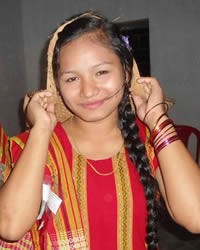
Photo Source:
Anonymous
|
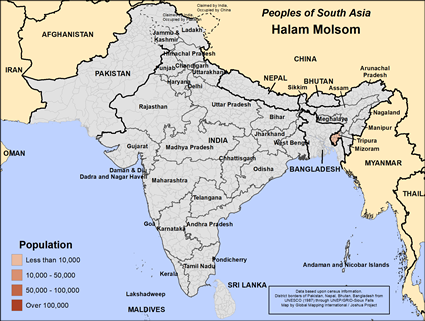
Map Source:
People Group data: Omid. Map geography: UNESCO / GMI. Map Design: Joshua Project
|
| People Name: | Halam Molsom |
| Country: | India |
| 10/40 Window: | Yes |
| Population: | 5,600 |
| World Population: | 5,600 |
| Primary Language: | Kok Borok |
| Primary Religion: | Hinduism |
| Christian Adherents: | 48.47 % |
| Evangelicals: | 0.00 % |
| Scripture: | Complete Bible |
| Ministry Resources: | Yes |
| Jesus Film: | Yes |
| Audio Recordings: | Yes |
| People Cluster: | South Asia Tribal - other |
| Affinity Bloc: | South Asian Peoples |
| Progress Level: |

|
Introduction / History
Defining a people group can be tricky. That is the case with the Molsom Halam in Tripura state, India, who speak Kok Borok, a Sino-Tibetan language. Several scholars see them not as a subgroup of Halam, but as a separate tribe in their own right. And if so, then they should qualify for Scheduled Tribe status.
Thay are not indigenous to the area, having come to their present location from present-day Myanmar (Burma) and Mizoram in northeast India, sometime in the 1500s. They have, however, no written record of their migration; only oral traditions and genealogies to indicate that. At that time, however, Tripura state was a kingdom, the Indian subcontinent being a collection of states, not a unified nation state.
What Are Their Lives Like?
Whatever the past, the Molsom Halam today live in mountains in clusters of villages in forest clearings, their houses built on stilts. Those houses may be constructed of timber or thatch. In these villages, the Molsom Halam live lives regulated by customary law and rituals; entertained by dance, music, and games. There are special dances for harvest festivals (e.g., the haihak dance).
Their economy is agrarian and livestock raising. Agriculture is subsistent. Fields may be permanent or shift to new soils as so il becomes less fertile. Agriculture is supplemented by gathering food plants from the forest. They also weave cotton cloth.
What Are Their Beliefs?
The Molsom Halam have both indigenous traditional and non-traditional beliefs. Traditional beliefs are animistic, appeasing spirits and venerating ancestors who influence daily life. These traditional beliefs and practices came to mix with non-traditional Hinduism. There is also a Christian witness among them, but most identify as Hindu. They have a complete Bible translation, so there is a foundation.
What Are Their Needs?
Like most tribal groups in India, they need improved health and hygiene and health education. They also need education and improved agricultural technology and infrastructure. Additionally, they need the government to recognize them as a Scheduled Tribe separate from the Halam peoples.
Prayer Points
Pray for the preservation of their language and culture; and for Scheduled Tribe status that might preserve their language and culture.
Pray for Christian agronomists, medical clinics, and hygienists.
Pray for freedom from fear of spirits and power encounters that will show God's absolute power over the spirit world.