Chhipa (Muslim traditions) in India

Photo Source:
Anonymous
|
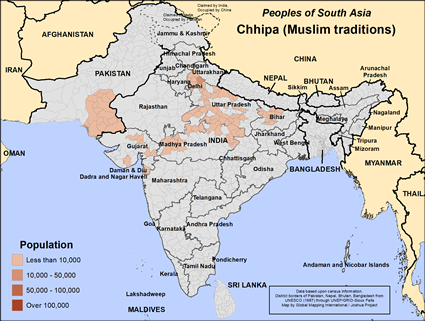
Map Source:
People Group data: Omid. Map geography: UNESCO / GMI. Map Design: Joshua Project.
|
| People Name: | Chhipa (Muslim traditions) |
| Country: | India |
| 10/40 Window: | Yes |
| Population: | 88,000 |
| World Population: | 93,400 |
| Primary Language: | Urdu |
| Primary Religion: | Islam |
| Christian Adherents: | 0.00 % |
| Evangelicals: | 0.00 % |
| Scripture: | Complete Bible |
| Ministry Resources: | Yes |
| Jesus Film: | Yes |
| Audio Recordings: | Yes |
| People Cluster: | South Asia Muslim - other |
| Affinity Bloc: | South Asian Peoples |
| Progress Level: |

|
Introduction / History
The Chhipa are a traditionally textile-printing community found primarily in western and northern India, especially in regions historically associated with cotton production and textile craftsmanship. Their name is commonly linked to the practice of printing and dyeing cloth, an occupation that has been passed down through generations. Over time, portions of the community adopted Islam while retaining many cultural customs that developed within the broader Indian environment. The Chhipa identified with Muslim traditions represent one of several religious communities associated with this occupational heritage.
For centuries, Chhipa artisans contributed to India's renowned textile industry. Using hand-carved wooden blocks, natural dyes, and intricate patterns, they produced fabrics for local use and regional trade. Their skills were highly valued in marketplaces where handcrafted textiles played an important role in daily life and commerce. As industrial production expanded, many traditional artisans adapted by combining older techniques with modern methods, while others sought employment in different sectors of the economy.
Today, the Chhipa continue to be recognized for their connection to textile work, though their occupations have diversified significantly. Many families remain connected to urban and semi-urban centers where trade, manufacturing, and small businesses provide employment opportunities.
What Are Their Lives Like?
Family and community relationships form the foundation of Chhipa society. Extended families often maintain close ties, providing support during weddings, funerals, religious celebrations, and times of financial need. Respect for parents and elders remains an important cultural value, and family reputation is often closely connected to personal conduct and community participation.
Historically, many Chhipa families earned their living through cloth printing, dyeing, tailoring, and related textile trades. Skilled artisans learned techniques from older generations, passing specialized knowledge from parents to children. Traditional workshops frequently operated as family enterprises, with multiple members contributing to different stages of production, from preparing fabrics and mixing dyes to printing patterns and marketing finished goods.
Although textile work remains important for some families, modern economic realities have led many Chhipa to pursue a wider range of occupations. They may work as merchants, shopkeepers, factory employees, transportation workers, craftsmen, government employees, educators, or small-business owners. Younger generations increasingly seek education and professional careers while maintaining connections to their cultural heritage.
Food reflects both regional Indian cuisine and Muslim dietary customs. Meals commonly include flatbreads or rice accompanied by lentils, vegetables, meat dishes where affordable, and a variety of spices. Hospitality is highly valued and sharing meals with relatives and guests helps strengthen family bonds.
Community life is often centered around local neighborhoods, mosques, marketplaces, and family gatherings. Religious holidays and social celebrations provide opportunities for strengthening relationships and preserving cultural traditions. Weddings are particularly important occasions, bringing together extended family networks and reinforcing community identity.
While many Chhipa families have benefited from urbanization and economic development, others continue to face challenges related to employment stability, educational opportunities, and rising living costs. Nevertheless, they remain a resilient community with a strong sense of identity rooted in both their occupational heritage and religious traditions.
What Are Their Beliefs?
The Chhipa who follow Muslim traditions identify as Muslims and generally adhere to the basic teachings and practices of Islam. Their religious life often includes regular prayer, fasting during Ramadan, charitable giving, and participation in Islamic festivals such as Eid al-Fitr and Eid al-Adha.
As with many communities in South Asia, religious practice may vary from family to family. Some combine orthodox Islamic beliefs with customs influenced by local culture and longstanding regional traditions. Reverence for religious leaders, visits to shrines, and other customary practices may be present in some segments of the community.
Islam shapes important life events, including birth ceremonies, marriage customs, and funeral practices. Religious instruction is often received through family members, local mosques, and community leaders.
Despite their religious heritage, many Chhipa have had little opportunity to hear a clear presentation of the gospel or to encounter followers of Jesus Christ who can explain biblical truth in a culturally meaningful way. As a result, access to the message of salvation through Christ remains limited for much of the community.
What Are Their Needs?
The Chhipa have both spiritual and practical needs. Spiritually, they need opportunities to hear and understand the gospel in their own language and cultural context. Many have never developed a personal relationship with a Christian believer who can demonstrate the love of Christ and explain the message of salvation found in Scripture.
The community would benefit from faithful Christian workers who are willing to build genuine friendships, serve with humility, and share biblical truth with patience and respect. Access to Christian literature, Scripture resources, and discipleship opportunities remains important for those who become interested in learning about Jesus.
Practically, some Chhipa families face challenges related to education, employment, business development, and healthcare. Economic changes within the textile industry have affected traditional livelihoods in certain areas, creating a need for new opportunities and vocational advancement. Continued access to quality schools, medical care, and sustainable employment can contribute to healthier and more stable communities.
Prayer Points
Pray that the Chhipa people will be adopted through the People Group Adoption program so that ongoing prayer, compassionate ministry, and future gospel engagement will reach their communities.
Pray that Christians will be led by the Holy Spirit to build meaningful relationships with the Chhipa and faithfully share the good news of Jesus Christ with them.
Pray that many Chhipa men, women, and children will develop a deep spiritual hunger that leads them to seek Jesus Christ and follow Him no matter what the cost.
Pray that God will provide improved educational opportunities, healthcare services, employment options, and other resources that strengthen Chhipa families and communities.