Bairagi (Muslim traditions) in India

Send Joshua Project a photo
of this people group. |
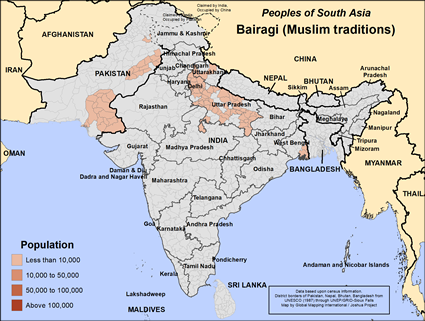
Map Source:
People Group data: Omid. Map geography: UNESCO / GMI. Map Design: Joshua Project
|
| People Name: | Bairagi (Muslim traditions) |
| Country: | India |
| 10/40 Window: | Yes |
| Population: | 19,000 |
| World Population: | 22,500 |
| Primary Language: | Urdu |
| Primary Religion: | Islam |
| Christian Adherents: | 0.00 % |
| Evangelicals: | 0.00 % |
| Scripture: | Complete Bible |
| Ministry Resources: | Yes |
| Jesus Film: | Yes |
| Audio Recordings: | Yes |
| People Cluster: | South Asia Muslim - other |
| Affinity Bloc: | South Asian Peoples |
| Progress Level: |

|
Introduction / History
The Bairagi (Muslim traditions) are a small Muslim community found mainly in the Indian states of Uttar Pradesh and Uttarakhand, with smaller populations elsewhere in northern India. Their name comes from the Sanskrit word vairagya, meaning "renunciation" or "detachment," reflecting historical roots connected to ascetic and devotional religious traditions in South Asia. Although they are now Muslim, aspects of their history and identity show influence from older Hindu devotional movements and regional religious traditions.
Historically, some Bairagi groups were associated with spiritual teachers, wandering ascetics, and devotional religious communities. Over time, portions of the community adopted Islam while retaining certain cultural patterns and devotional practices shaped by the broader religious environment of northern India. Mughal rulers are said to have granted land to some Bairagi communities in earlier centuries, which contributed to their social standing in certain regions.
The Bairagi (Muslim traditions) primarily speak Urdu and are part of the wider cultural world of North Indian Islam. Their identity reflects centuries of interaction between Islamic and Hindu devotional traditions in South Asia. Despite living in regions with long religious history and diversity, very few Bairagi have encountered clear biblical teaching or lasting Christian witness.
What Are Their Lives Like?
The Bairagi community has preserved a distinct social identity despite major cultural and economic changes in modern India. Family and community loyalty remain important, and many continue to marry within their own social circles. Their lives are shaped by the broader culture of northern Indian Muslim society while still retaining unique traditions connected to their historical background.
One notable contribution of the Bairagi community is their connection to qawwali music and Urdu literary culture. Qawwali, a form of devotional music associated especially with Sufi traditions, remains influential in many North Indian Muslim communities. Poetry, storytelling, and devotional gatherings continue to play an important role in preserving identity and transmitting cultural values.
Most Bairagi live in towns and villages where livelihoods vary widely. Some families work in trade, labor, small business, crafts, or local services. Education levels differ by region and economic opportunity. Like many communities in northern India, younger generations increasingly face pressure from urbanization, migration, and changing economic expectations.
Meals commonly include flatbreads, rice, lentils, vegetables, tea, and regional meat dishes. Hospitality and respect for elders remain valued cultural traits. Religious festivals, family gatherings, and shrine-related events often serve as major points of community interaction.
What Are Their Beliefs?
The Bairagi (Muslim traditions) are Sunni Muslims, but many also practice forms of folk Islam influenced by Sufi traditions and older South Asian devotional customs. Devotion to spiritual leaders known as pirs or fakirs plays a major role in their religious life. Many visit shrines associated with these leaders and participate in ceremonies honoring their lives and teachings.
Their religious practices reflect a syncretistic blend of Islamic and Hindu-influenced devotional traditions. Spiritual blessing, healing, protection, and guidance may be sought through shrines, prayers connected to saints, devotional music, and ritual observances. Such practices often place heavy emphasis on intermediaries and spiritual figures rather than direct trust in God alone.
Religious identity is deeply connected to family and community belonging. Following Christ can therefore bring social pressure, misunderstanding, or rejection from relatives and neighbors. Very few known believers live among the Bairagi (Muslim traditions), and access to biblical discipleship and Christian fellowship remains extremely limited.
What Are Their Needs?
The Bairagi (Muslim traditions) need clear access to the gospel in culturally understandable ways and in the Urdu language they commonly use. Many have never heard a biblical explanation of salvation through Jesus Christ alone. Long-term Christian witness rooted in humility, compassion, and truth is greatly needed among them.
There is also a need for Scripture resources, audio Bible materials, discipleship tools, and mature believers willing to build relationships patiently within the community. Because spiritual traditions and family identity are deeply intertwined, gospel ministry requires wisdom, consistency, and long-term commitment.
Practical needs vary by region but may include educational opportunity, employment stability, and support for families facing economic hardship. Ministry efforts that combine compassionate service with faithful biblical teaching may help open doors for meaningful relationships and lasting gospel witness.
Prayer Points
Pray that the Bairagi (Muslim traditions) would come to understand that forgiveness and eternal life are found only through Jesus Christ and not through devotion to spiritual leaders or shrines.
Pray that God would raise up faithful Christian workers who are willing to serve among the Bairagi community with wisdom, humility, and perseverance.
Pray that the Bairagi (Muslim traditions) would be adopted through the People Group Adoption program so they receive sustained prayer, ongoing gospel engagement, and future discipleship efforts.
Pray that any believers living among Urdu-speaking Muslim communities in northern India would grow bold in sharing the truth of Christ with the Bairagi and neighboring peoples.