Koria in India

Send Joshua Project a photo
of this people group. |
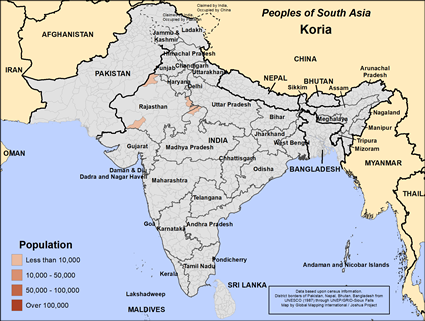
Map Source:
People Group data: Omid. Map geography: UNESCO / GMI. Map Design: Joshua Project
|
| People Name: | Koria |
| Country: | India |
| 10/40 Window: | Yes |
| Population: | 2,100 |
| World Population: | 2,100 |
| Primary Language: | Hindi |
| Primary Religion: | Hinduism |
| Christian Adherents: | 0.00 % |
| Evangelicals: | 0.00 % |
| Scripture: | Complete Bible |
| Ministry Resources: | Yes |
| Jesus Film: | Yes |
| Audio Recordings: | Yes |
| People Cluster: | South Asia Dalit - other |
| Affinity Bloc: | South Asian Peoples |
| Progress Level: |

|
Introduction / History
In India, the term Koria refers to an indigenous Scheduled Tribe primarily living in the state of Rajasthan, or it is often used as a variation of the Korwa people—a designated Particularly Vulnerable Tribal Group (PVTG) found in Central India. Kori or Koli is an Indian caste, who were traditionally fishermen (in coastal areas), weavers (in Northern States) and farmers (especially in Gujarat). Other names for this caste include Banodha, Vaish, Koli, Mahour, Mahawar, Anuragi, Kabirpanthi and Julaha. The Kori are classified as a Scheduled Caste in the states of Haryana, Himachal Pradesh, Madhya Pradesh, Odisha, Punjab, Rajasthan, Uttar Pradesh, Chhattisgarh, and Uttarakhand as well as in the Union Territory of Chandigarh. In the past the Kori had Other Backward status in Meerut, Agra, Rohilkhand and its neighboring cities. In Delhi, Rajasthan, Gujarat, Maharashtra and Southern States the Kori caste is known as Koli. By the 1960s, all of the Koris in the villages had adopted roles as agriculturist, ploughmen, and midwives, because industrialization had made their traditional occupation as weavers redundant.
Before the partitioning of India in 1947, the Kori, a Koli caste who migrated from Gujarat at the turn of the century, were accorded low status by Sind's Muslims and Hindus alike. Their occupation as land-less laborers and their semi-nomadic lifestyle reinforced their designation as "Scheduled Caste". When the higher caste Hindus fled Sind after Partition, the situation changed. The majority of Kori remained behind.
What Are Their Lives Like?
They are primarily an agricultural and hunter-gatherer community. Traditionally, they have grown crops like rice and maize and supplemented their diet by fishing and gathering from the forest. The Koria people have a tradition of folk dances, unique music, and art. They are mostly Hindu, practicing various rituals dedicated to ensuring a good harvest.
What Are Their Beliefs?
Most of the Kori practice Hinduism through the worship of gods and goddesses, deities, and celebrate major Hindu festivals.
What Are Their Needs?
They need access to clean drinking water, Accessible medical facilities, better up to date sanitation, sustainable employment, better access to formal banking instead of moneylenders who charge exorbitant fees. They also need quality education for children and help assistance with dealing with bureaucracies which is essential for receiving government benefits.
Prayer Points
Pray that they would realize and believe that Jesus accepts them as they are.
Pray for teachers and discipleship workers.
Pray that after conversion they will be a good witness in the everyday lives.
Pray for protection against mob violence.
Pray for the Holy Spirit to move among them, blessing them in every way, and drawing them into the loving arms of Jesus Christ.