Devhar in India

Send Joshua Project a photo
of this people group. |
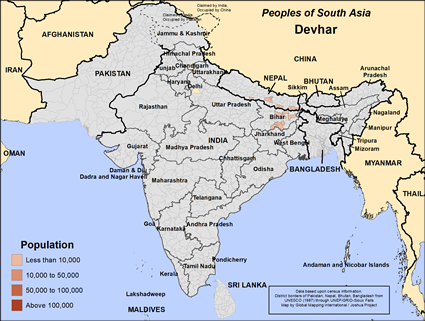
Map Source:
People Group data: Omid. Map geography: UNESCO / GMI. Map Design: Joshua Project
|
| People Name: | Devhar |
| Country: | India |
| 10/40 Window: | Yes |
| Population: | 18,000 |
| World Population: | 18,000 |
| Primary Language: | Hindi |
| Primary Religion: | Hinduism |
| Christian Adherents: | 0.00 % |
| Evangelicals: | 0.00 % |
| Scripture: | Complete Bible |
| Ministry Resources: | Yes |
| Jesus Film: | Yes |
| Audio Recordings: | Yes |
| People Cluster: | South Asia Hindu - other |
| Affinity Bloc: | South Asian Peoples |
| Progress Level: |

|
Introduction / History
The Devhar people are a lesser-known community found primarily in the central and northern regions of India, including states of Karnataka, Maharashtra, Telangana, and Andhra Pradesh. The Devhar also go by the names of Deva or Devi. The origins of the Devhar are somewhat obscure, but they are often associated with traditional occupations linked to religious service, folk healing, or ritual performance. Over generations, the Devhar have maintained a distinct identity, shaped by their roles in village life and their unique cultural practices. Despite social and economic changes, they continue to preserve their traditions and contribute to the diversity of India's rural landscape.
They are a scheduled caste community, which means they have low status in Hindu society. Their primary language is Hindi, though some also speak local dialects depending on their region. These dialects include Maithili and Magahi.
What Are Their Lives Like?
Life among the Devhar is closely tied to family and community. Households are typically extended, with several generations living together or nearby, and elders playing a significant role in guiding family decisions and upholding traditions. Many Devhar families rely on agriculture, working as small-scale farmers or laborers, while others may be involved in traditional crafts or local trades. In some areas, members of the community are known for their roles as ritual specialists, healers, or musicians, serving at village festivals and religious ceremonies. Many Devhar have been disadvantaged economically. The Indian government has attempted to help uplift the Devhar people through quotas for higher education and government jobs.
Community gatherings, especially during festivals and harvest celebrations, are important occasions for socializing, sharing meals, and reinforcing communal bonds. Despite facing economic challenges, the Devhar display resilience and a strong sense of solidarity, supporting one another through both hardship and celebration.
What Are Their Beliefs?
The Devhar are traditionally Hindu and have their own traditions and practices with their religious life deeply intertwined with local customs and folk practices. They worship a variety of Hindu deities, including Hindu gods and goddesses, often focusing on village gods and goddesses believed to protect their families and crops.
Additionally, they have their own set of rituals and customs related to birth, marriage, and death. Rituals, offerings, and participation in festivals are central to their spiritual expression. Many Devhar also hold animistic beliefs, attributing spiritual power to natural elements such as trees, rivers, and stones, and seeking guidance or healing from ancestral spirits. These practices reflect a heartfelt desire for connection with the divine and for protection in daily life.
What Are Their Needs?
The Devhar community faces a range of physical and spiritual needs. Materially, many struggle with poverty, limited access to education, and inadequate healthcare. Children may leave school early to help support their families, and women often bear a significant share of both household and agricultural labor. Improved access to clean water, sanitation, and vocational training would greatly benefit their communities and open doors to new opportunities. Socially, the Devhar value unity and mutual support, but younger generations sometimes face pressure to leave behind their cultural heritage in pursuit of modern livelihoods.
The Devhar community is unaware of the truth of the saving grace of Jesus Christ. The message of the gospel offers them the assurance of God's love, forgiveness, and a new identity as children of God, regardless of background or tradition.
Prayer Points
Pray that God would stir up a passion in the hearts of his people to adopt the Devhar people, leading them to unite in prayer, financial support, and partnership to establish the presence of the gospel of Jesus Christ within their community.
Pray that God would send loving, committed workers to the Devhar people who will share the message of Jesus.
Pray that the Lord would stir within the Devhar a desire for truth and a hunger for him, leading them to embrace Jesus as Savior, whatever the cost.
Pray that the truth of the gospel will no longer be hidden from them.
Pray for the Lord to bless the Devhar community economically and spiritually in providing them with greater access to quality education, healthcare, and economic opportunities, enabling them to break cycles of poverty and hardship.