Sonsorol in Micronesia, Federated States
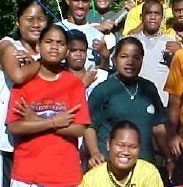
Photo Source:
Anonymous
|
Send Joshua Project a map of this people group.
|
| People Name: | Sonsorol |
| Country: | Micronesia, Federated States |
| 10/40 Window: | No |
| Population: | 800 |
| World Population: | 1,600 |
| Primary Language: | Sonsorolese |
| Primary Religion: | Christianity |
| Christian Adherents: | 90.00 % |
| Evangelicals: | 6.00 % |
| Scripture: | Portions |
| Ministry Resources: | Yes |
| Jesus Film: | No |
| Audio Recordings: | No |
| People Cluster: | Micronesian |
| Affinity Bloc: | Pacific Islanders |
| Progress Level: |

|
Introduction / History
Tucked into the far southwestern reaches of the Pacific Ocean, the Sonsorol people inhabit one of the most remote corners of the Republic of Palau. Their homeland — the Southwest Islands of Sonsorol State — consists of four small coral islands: Sonsorol (also called Dongosaru), Pulo Anna, Merir, and Fanna, sitting roughly 300 kilometers from Palau's main island group. A diaspora community also lives among the Federated States of Micronesia.
Tradition holds that the Sonsorolese trace their origins to ancestral voyagers — survivors of canoes that drifted from Ulithi Atoll, northeast of Yap — who eventually settled these remote islands. Their linguistic roots reflect this heritage: Sonsorolese belongs to the Chuukic branch of Micronesian languages, sharing kinship with outer island tongues of Yap and Chuuk Lagoon rather than with the Palauan language spoken across most of the republic. The language remains officially recognized alongside Palauan and English within Sonsorol State.
European contact came early. Spanish explorers sighted the islands as far back as 1521, and in 1710 a Jesuit expedition became the first recorded outside contact with the people. The islands passed through Spanish, German, and Japanese colonial administration before coming under United States oversight after World War II as part of the UN Trust Territory of the Pacific Islands. Palau gained full independence in 1994, and Sonsorol State adopted its own constitution in 1983. The islands suffered severe damage from Typhoon Bopha in 2012, forcing widespread evacuation. Though some residents eventually returned, only the main island of Sonsorol remains inhabited today.
Out-migration to urban centers — particularly Koror — has dramatically reduced the resident island population over recent decades. Many Sonsorolese now live in Koror while maintaining ties to their island homeland.
What Are Their Lives Like?
Life on Sonsorol Island moves at a slow, deliberate pace shaped entirely by the sea and the land. Fishing forms the backbone of daily sustenance, with the surrounding waters offering abundant reef fish. Coconuts, taro, and other tropical staples supplement the diet, and the dense interior forest provides a backdrop for a largely self-sufficient way of life. There are no vehicles on the islands, and the only access comes through periodic government supply ships or live-aboard vessels — a reality that both preserves the islands' character and deepens their isolation.
Family and clan bonds are foundational. Unlike most of Palau, which operates under a strictly matrilineal system for chiefly succession, the Sonsorolese observe a unilineal pattern allowing chiefs — known by the title Nurap — to come from either the mother's or father's line. Remnants of traditional meeting houses, called Faremau, can still be found on the islands, testifying to a structured community life centered on chiefly authority and collective decision-making.
The Sonsorolese carry one of the Pacific's most remarkable seafaring traditions. Knowledge of traditional navigation and canoe-building — largely lost elsewhere in Palau — has survived here precisely because of the islands' distance from outside influence. Ten traditional dances performed at Palau's National Day celebrations encode historical narratives through gesture and movement, preserving stories in a language that has otherwise fallen silent in everyday speech. Children who wish to pursue secondary education must travel to Koror, 300 kilometers away, to attend Palau High School — a journey that often means extended separation from family.
What Are Their Beliefs?
The overwhelming majority of the Sonsorolese identify as Christians, and Christianity has been the dominant religious framework for the community for generations. The presence of Evangelical believers is meaningful, though the depth and vitality of that faith across the broader community varies. A small portion of the population falls outside the Christian category entirely.
Alongside nominal Christian affiliation, traditional spiritual practices rooted in the pre-Christian past likely persist to some degree in daily life. Pacific island communities frequently integrate older beliefs about spiritual forces — ancestors, the sea, the land — into their worldview alongside formal religious identity. Where this occurs among the Sonsorolese, it represents genuine trust in spiritual systems and powers, not merely cultural habit. Such beliefs, however sincerely held, cannot offer what only Jesus Christ provides: forgiveness, reconciliation with God, and eternal life.
The Bible has been partially translated into Sonsorolese, and YouVersion makes an existing Sonsorolese version available digitally. A complete New Testament in the language has not yet been produced, leaving a significant gap in accessible Scripture for those whose heart language is Sonsorolese.
What Are Their Needs?
The physical needs of the Sonsorolese are shaped by their extraordinary isolation. Access to healthcare, reliable food sources, and infrastructure remains precarious on a small island reachable only by periodic ship. The threat of typhoons is ever-present, as the devastation of 2012 demonstrated, and climate change poses a long-term existential risk to low-lying coral islands like those of Sonsorol State. Young people face a painful choice between education and remaining near family, and many who leave for Koror or beyond gradually lose connection to their language and heritage.
Spiritually, the Sonsorolese need more than nominal Christian affiliation — they need a living, transforming encounter with the gospel of Jesus Christ. The lack of a complete New Testament in Sonsorolese means that many believers access Scripture only in Palauan or English, limiting how deeply the Word can penetrate heart and community. Evangelical believers within the Sonsorolese community have an extraordinary opportunity to model genuine faith and share the gospel with neighbors whose Christianity may be more inherited than personal.
Prayer Points
Pray that Sonsorolese Evangelical believers will grow in their faith and boldly share the gospel with those in their community whose Christian identity is nominal.
Pray for the completion of a full New Testament in Sonsorolese, and for wide distribution and engagement with Scripture in the heart language of the people.
Pray for God's protection over the islands from natural disaster, and for sustainable livelihoods that allow families to remain together and rooted in their homeland.
Pray that young Sonsorolese who leave for education and opportunity will encounter Christ and carry the gospel back to their island home.