Mama, Kwarra in Nigeria
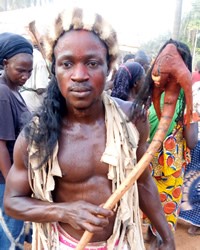
Photo Source:
Jujuhu Joseph Kwanahwah
|
Send Joshua Project a map of this people group.
|
| People Name: | Mama, Kwarra |
| Country: | Nigeria |
| 10/40 Window: | Yes |
| Population: | 75,000 |
| World Population: | 75,000 |
| Primary Language: | Mama |
| Primary Religion: | Ethnic Religions |
| Christian Adherents: | 20.00 % |
| Evangelicals: | 4.00 % |
| Scripture: | Translation Started |
| Ministry Resources: | No |
| Jesus Film: | No |
| Audio Recordings: | Yes |
| People Cluster: | Benue |
| Affinity Bloc: | Sub-Saharan Peoples |
| Progress Level: |

|
Introduction / History
Folded into the rocky hills and broken terrain of Nasarawa State, in Nigeria's North Central Middle Belt region, the Kwarra Mama — also called the Kantana or simply the Mama — occupy the Akwanga Local Government Area, a landscape shaped by millennia of settlement and, more recently, by the upheavals of the nineteenth century. "Kwarra" refers to their village and region, distinguishing this branch of the Mama people within the broader ethnic cluster. The Mama themselves are classified within the Benue people cluster and are found only in Nigeria.
Their history took a decisive turn roughly two hundred years ago when the Fulani jihad, radiating outward from Usman dan Fodio's expanding Sokoto Caliphate, swept through the plains of east-central Nigeria. Numerous smaller Mama groups and patriclans who had lived on the open plains were forced northward into the hills for protection, joining peoples already settled there and gradually absorbing many of their customs. Though the threat of Fulani expansion receded under British colonialism in the early twentieth century, many Mama families chose to remain in their mountain communities, and those highland roots continue to shape the community's identity and isolation.
The language spoken by the Kwarra Mama is known simply as Mama (ISO: mma), a Jarawan language within the Niger-Congo family. Related to other languages of the region, it has been spoken for generations as the language of home, field, and ceremony, though the population of fluent speakers — particularly among younger generations — has declined over time. Hausa serves as the lingua franca for trade and inter-ethnic communication across the broader Akwanga area, and English functions in formal education and government.
What Are Their Lives Like?
Guinea corn (sorghum) is the cornerstone of Mama subsistence. Men clear the land and tend the fields, while the harvest feeds the household and supplies the raw material for the community's most important social lubricant: beer. Brewed by women from guinea corn, beer is woven into the fabric of daily interaction — shared at gatherings, offered to guests, and presented in acts of spiritual observance directed at ancestral spirits. Beer was historically not a commodity to be sold but a gift exchanged within webs of social obligation; men provided guinea corn to their wives, who returned it as beer. Though that practice has shifted in recent years, with women now marketing beer commercially, it remains culturally freighted in ways that go well beyond the drink itself. Yam, cassava, and other crops also figure in the agricultural economy of the broader Nasarawa region.
The Kwarra Mama live in compounds of mud-walled houses that shelter extended family networks. Social life turns on the clan — both patrilineal and matrilineal lines carry obligations — and elders hold authority in matters of land, marriage, and community governance. Village leaders carry wooden staffs and shoulder crooks as recognized prestige markers. Artistic life has long been bound up with the sacred: the Mama are skilled producers of wooden masks, carved statuary, and ritual objects, with the buffalo and antelope recurring as symbols of harvest prosperity and ancestral power. The Mada, Eggon, Goemai, and other neighboring peoples of this hilly Middle Belt zone share a broadly similar landscape of subsistence farming, clan-based society, and traditional religious practice.
What Are Their Beliefs?
Ethnic religion commands the allegiance of the majority of Kwarra Mama. At the center of their cosmology stands a supreme god associated with the sun — an overarching creator power who nonetheless does not engage directly with daily human affairs. It is the ancestors who mediate between that creator and the living world. The dead are conceived as subterranean beings, residing beneath the ground in a realm parallel to the village, from which they exercise direct influence over the living. They are not passive presences. The ancestors must be acknowledged, appeased, and given offerings — beer among the most prized of these — lest they withhold favor or send illness and misfortune to their descendants. Failure to maintain proper observance is understood as an invitation for harm.
The Mama's spiritual life is given vivid material form through the mangam cult and its associated masking ceremonies. Large wooden masks — representing a composite of nature, the divine, and ancestral power — are worn atop the head with raffia costumes in rituals designed to achieve balance between the world of the dead, the natural world, and the living village. Buffalo skulls embedded in mud walls mark the presence of the ancestor cult, and the carved masks tied to buffalo and antelope imagery signal both agricultural blessing and spiritual authority. Masquerades and cults are the institutional mechanisms by which the unseen world is negotiated and held in check.
Christianity has reached a portion of the Kwarra Mama, and a modest evangelical community has taken root alongside a broader group of Christian adherents. Islam has also made inroads, accounting for a significant share of the population. Yet neither Christianity nor Islam has displaced the deep structures of traditional belief; for many who claim one of these labels, the ancestral framework continues to operate beneath the surface. Global Recordings Network has produced audio gospel materials in the Mama language — a meaningful starting point — but Bible translation work has only just begun, meaning the church currently has no written Scripture in the mother tongue to anchor its faith and withstand the pull of the spirit world.
What Are Their Needs?
The Middle Belt context of Nasarawa State brings its own pressures. Farmer-herder conflicts, which have intensified across this region in recent years, pose a recurring threat to security, livelihoods, and community stability. Healthcare access in the hilly Akwanga area remains limited, with few clinics and trained health workers available to serve dispersed rural populations. Maternal and child health is particularly vulnerable to this gap. Educational opportunities for young people — especially girls — are constrained by poverty, distance, and traditional expectations. Clean water infrastructure and road connectivity lag behind the needs of communities spread across difficult terrain. Nigeria's ranking among the most dangerous countries in the world for Christians adds yet another layer of concern for the small believing community.
Spiritually, the unfinished Bible translation stands as the most pressing need. A church that can only hear the gospel through audio recordings, without the written Word to read, memorize, teach, and pass on in the language of the heart, is a church whose roots have not yet gone as deep as they need to.
Prayer Points
Ask the Lord God — whose authority over life, death, and the ancestral realm is absolute — to make Himself known among the Kwarra Mama, drawing men and women away from offerings to the dead and into living relationship with Jesus Christ, who alone holds power over every spiritual force.
Pray with urgency for the completion of Bible translation in the Mama language, asking God to bring skilled translators, mother-tongue collaborators, and the organizational support needed to move this vital work from beginning to finish.
Ask God to strengthen and mature the evangelical community among the Kwarra Mama, raising up teachers and leaders who will speak the full truth of the gospel without compromise or accommodation to the ancestral cult.
Pray for healthcare workers, educators, and peacekeepers willing to serve this isolated community, addressing the physical deprivations that open the door to spiritual conversation.